



Expansive fields of flowering white daisies are sure to catch your eye if you’re driving through north-west Tasmanian during the summer months, but do you know what the plant is grown for?
Tasmania is the world’s largest supplier of pyrethrin, a natural plant-based insecticide found in the dried flower heads of the pyrethrum plant. The coastline around northern Tasmania is covered with white flowers during summer and it’s an important and lucrative crop for the region.
Pooja Poosarla is a PhD candidate at the Tasmanian Institute of Agriculture (TIA) and while she hadn’t seen a pyrethrum plant before arriving in north-west Tasmania, she was excited about the opportunity to work on an agricultural science project that blended laboratory and field work.
“My PhD project is focussed on understanding the extent of fungicide resistance in two fungal pathogens (ray blight and tan spot) which cause diseases of pyrethrum, and I’m looking at and how fungicide resistance spreads. I will also be developing tools that industry can use to monitor the sensitivity of pathogens to specific fungicides,” Pooja said.
“The industry has identified this as an important area of focus and my research findings have potential to help growers be more productive and achieve higher yields through improved disease management.
The research is a partnership between TIA and Botanical Resources Australia (BRA). Pooja also worked with BRA in their research laboratory, which provided an opportunity to grow her knowledge and understanding of the industry and build her professional network.
“The long-running collaboration between BRA and TIA has been a key factor to the success of pyrethrum as a crop in Australia. Pooja’s project is providing new insights to help us manage disease and resistance more effectively,” Dr Kristin Groom, R&D Manager for Agriculture at BRA, said.
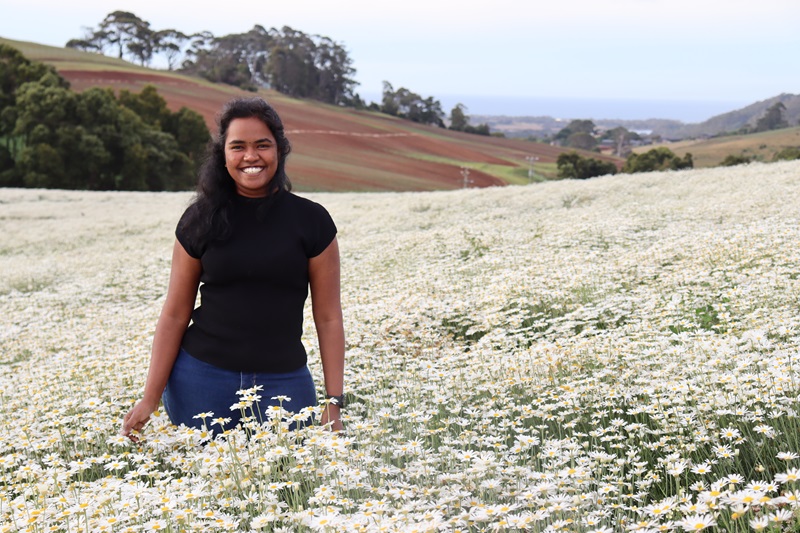
As part of the PhD project, three trial sites were established in north-west Tasmania including two sites at Gawler within commercial crops. Another trial site was established at Black River near Stanley, this site was intentionally established 35km away from the nearest growing region to assess how disease and fungicide resistance individuals spread in an isolated site.
Pooja has now seen her fair share of pyrethrum plants, and over the past two years has meticulously collected almost 2000 samples of fungal pathogens from pyrethrum seeds, leaves and flowers from the industry and field trial sites.
Working in TIA’s new research laboratory at The Makers Technology and Innovation Hub in Burnie, Pooja had the task of undertaking genetic analysis on each of the samples.
“I am extracting DNA from each pathogen sample to analyse the DNA to see if it contains any mutations in genes that result in resistance to particular fungicides. I’m also looking at genetic diversity and mating type genes which are indicators of pathogen population diversity that might lead to an increased risk of fungicide resistance developing,” Pooja said.
“I hope my research can inform industry and in turn, growers about which fungicides to use and when to use them based on fungicide resistance levels.”
Pooja studied an undergraduate degree in life sciences (Microbiology, Biotechnology and Biochemistry) and a Master of Biotechnology in India, before moving to Tasmania to study a Master of Applied Science,Agricultural Science. She then moved to north-west Tasmania, the main growing region for pyrethrum in Australia, to undertake a PhD under the supervision of Dr Tamieka Pearce and Dr Jason Scott.
Pooja has immersed herself in activities while living on-campus at University’s unique waterfront setting, making friends through involvement in campus life, and volunteering in the local community.
“I’ve always been passionate about research, and I love being in the lab behind a microscope and being outdoors and involved in managing field trials,” Pooja said.
“I’ve always wanted to be in agriculture so now that I’m in agriculture and working in research it’s my dream come true.”
Looking to the future, Pooja is keeping her options open for now but is interested in a career involving research or extension with industry.