

Overview (2027)

Key Information


 Commonwealth Supported and Full Fee Paying places available (check your Letter of Offer for details)

Duration
Minimum 2 years, up to a maximum of 5 years.


Location
 CRICOS: 093656A
Duration
Minimum 2 years, up to a maximum of 5 years.
Location

Jade Zhang
Master of Laboratory Medicine student
Your career in Laboratory Medicine starts here
Laboratory Medicine is at the heart of modern healthcare. Almost every diagnosis depends on accurate laboratory results, and skilled professionals are needed to deliver them.
The Master of Laboratory Medicine prepares you to join this essential field with the right mix of theory and hands-on experience. In this practical, industry-focussed course you will study:
- Clinical chemistry
- Haematology
- Microbiology
- Histopathology
- Blood transfusion science
- Molecular biology and more
Each subject includes practical lab sessions, averaging three hours per unit per week, building real-world skills that employers value.
In your final semester, you will complete a 16-week Professional Experience Placement in an Australian laboratory. We help you find a placement that fits your goals, and many students are offered jobs by their host organisations before graduating.
This course attracts students from around the world. You will be part of a diverse and supportive community, with small classes and approachable teaching staff committed to your success.
In 2024, students rated the course:
- 100% for peer engagement, learning resources, and student support*
- Over 90% for teaching quality and skills development*
Graduates are in demand across hospitals, private labs, research centres, and public health. Starting salaries are strong, and the career opportunities are wide-ranging. Take your next step with confidence and join a course that prepares you for a meaningful and rewarding career.
Are you interested in laboratory medicine but don't yet have an undergraduate degree? We offer a four-year combined Bachelor of Biomedicine/Master of Laboratory Medicine if you are interested in a pathway to studying postgraduate Laboratory Medicine.
*Student Experience Survey 2024
- 1 Perform and interpret diagnostic laboratory tests and research activities; and evaluate and review quality systems and practice.
- 2 Design and conduct laboratory and literature investigations to solve laboratory medicine problems.
- 3 Communicate laboratory medicine investigation and/or research findings as appropriate for professional and academic environments.
- 4 Demonstrate effective, responsible, and safe work practices, in a medical laboratory with a high-level of autonomy and accountability, that meet the expected social, ethical and legal requirements of laboratory practice.
Practical Laboratory Training
From your first semester, you will take part in hands-on laboratory work that reflects real diagnostic settings.
Each unit includes approximately three hours of practical lab work per week. With a maximum student-to-staff ratio of 20 to 1, you will have more time to practise using industry-standard equipment and receive individual guidance.
We regularly update our facilities to reflect current industry needs. Recent upgrades include a biochemistry analyser, haematology analyser, coagulation analyser, and PCR analysis system. These are available for use during your studies and are also used by our active research staff.
In the 2024 Student Experience Survey, students gave 100 percent satisfaction for learning resources, which includes access to laboratory facilities and materials.
Become a Student Ambassador
Improve your communication, teamwork and leadership skills, meet new people, inspire and help others, and developing lasting friendships and networks as a student ambassador. Our ambassadors proudly represent the University throughout Tasmania in schools, at University and community events, and support a range of recruitment and engagement activities.
Though the Student Ambassador Program you will have many opportunities for training and professional development, experience in real-world community engagement and outreach, networking, and public speaking, plus end up with a key point of distinction on your CV.
Professional experience placement
In your final semester, you will complete a 16-week Professional Experience Placement (PEP) in a diagnostic pathology laboratory.
This is a key part of the course and a requirement of our accreditation with the Australian Institute of Medical Scientists (AIMS). Your placement must be in a laboratory accredited by the National Association of Testing Authorities (NATA) and must last no less than one academic semester.
During your placement, you will:
- Apply your skills in a real healthcare environment
- Gain a deeper understanding of how pathology supports patient care
- Develop your confidence and professional communication
- Build industry contacts that may lead to employment after graduation
We will support you in finding and preparing for your placement, including connecting you with a host laboratory and supervisor. Please note that during your placement, you’ll need to cover your own accommodation, transport and living expenses.
The Master of Laboratory Medicine is a professionally accredited degree. This course is accredited by the Australian Institute of Medical and Clinical Scientists (AIMS).
Graduates meet the requirements for Graduate membership of AIMS and can progress to full membership on the completion of 2-years postgraduate medical laboratory experience. For further membership requirements, please visit the Australian Institute of Medical and Clinical Scientists website.
If you have any queries about the accreditation process, please contact us for further information.
Career outcomes
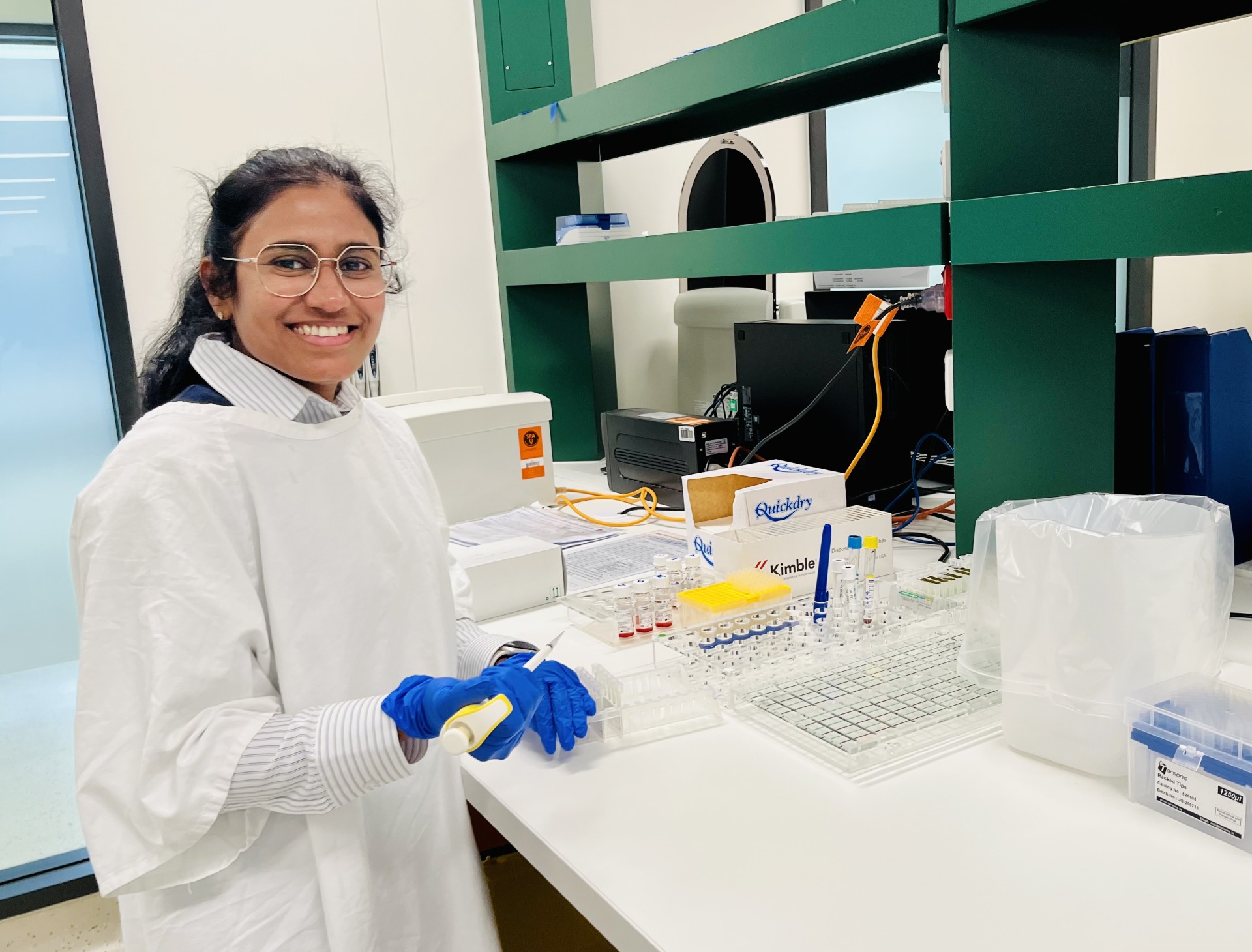
Tiruni Nilundika Amarasinghe Arachchige,
Master of Laboratory Medicine graduate
Career opportunities
Graduates of the Master of Laboratory Medicine are highly sought after in Australia and internationally.
This AIMS-accredited course prepares you for roles in diagnostic pathology, with major employers including:
- Hospitals
- Private pathology laboratories
- Blood transfusion services
- Public health and specialised labs
- Veterinary and animal health laboratories
- Pharmaceutical companies
- Medical research organisations
- Health technology and management sectors
You will graduate with practical laboratory skills and specialist knowledge that make you job ready. Whether you want to build a career close to home or explore international opportunities, this course gives you the flexibility to do both. Thanks to the breadth of disciplines covered and the 16-week Professional Experience Placement, many students secure employment before completing their studies.
In the 2024 Student Experience Survey, students gave 100% satisfaction for learning resources, student support, and peer engagement, with strong ratings for skills development. These results reflect the course’s commitment to preparing you for success in the workplace.
You may also choose to continue into postgraduate research, which can open further opportunities in biomedical science and academic careers.
The Master of Laboratory Medicine at the University of Tasmania is accredited by the Australian Institute of Medical and Clinical Scientists (AIMS). This accreditation demonstrates to prospective employers that graduates have the appropriate skills to work in diagnostic laboratories as Medical Laboratory Scientists.
For those wishing to apply to migrate to Australia under the General Skilled Migration visa categories, graduates of AIMS accredited programs are classified as a Medical Laboratory Scientist ANZSCO 234611 and are eligible for Professional membership of AIMS without sitting additional exams. See the AIMS website for further information.
Course structure
The Master of Laboratory Medicine provides you with core learning and skill development in all relevant laboratory medicine disciplines including clinical chemistry, haematology, blood transfusion science, genomics, microbiology, histopathology, human molecular biology.
In your final semester, you will undertake the 16-week Professional Experience Placement where you can practise your newly acquired skills, behaviours and knowledge in a workplace environment.
This unit explores how molecular genetics can be used to investigate and diagnose human disease. You will develop specialised knowledge of genetic variation, inheritance and the molecular basis of disease, and apply this knowledge to complex genetic problems. You will…
Credit Points: 12.5
| Location | Study period | Attendance options | Available to | ||
|---|---|---|---|---|---|
| Launceston | Semester 1 |  |  |  | |
- Key:
- On-campus
 Off-Campus
- International students
- Domestic students
In Haematology 1, you will study blood cells, the blood-forming organs, and some blood diseases, including their aetiology, diagnosis, monitoring and treatment. In the first half of the unit, you will study normal haemopoiesis, routine haematological screening procedures, recognition of…
Credit Points: 12.5
| Location | Study period | Attendance options | Available to | ||
|---|---|---|---|---|---|
| Launceston | Semester 1 | | | | |
- Key:
- On-campus
- Off-Campus
- International students
- Domestic students
In this unit, you will extend your practical skills in microbiological techniques to accurately identify medically relevant bacteria, drawing on advanced understanding of taxonomy and theoretical concepts. You will critically relate bacterial structure, function, and genetics to interpret growth, disease…
Credit Points: 12.5
| Location | Study period | Attendance options | Available to | ||
|---|---|---|---|---|---|
| Launceston | Semester 1 | | | | |
- Key:
- On-campus
- Off-Campus
- International students
- Domestic students
View all details for CXA641 General and Medical Microbiology
This unit develops expertise in the application and critical evaluation of biochemical investigations in the clinical laboratory. You will evaluate and apply quality assurance processes, including internal and external quality control, while developing advanced laboratory and analytical technical skills, including…
Credit Points: 12.5
| Location | Study period | Attendance options | Available to | ||
|---|---|---|---|---|---|
| Launceston | Semester 1 | | | | |
- Key:
- On-campus
- Off-Campus
- International students
- Domestic students
This unit develops your understanding of the pathological processes that underlie various human diseases at a cellular, tissue and organ level. Histopathological methods and microscopic recognition are used to demonstrate disease processes such as inflammation, fibrosis and neoplasia. A range…
Credit Points: 12.5
| Location | Study period | Attendance options | Available to | ||
|---|---|---|---|---|---|
| Launceston | Semester 2 | | | | |
- Key:
- On-campus
- Off-Campus
- International students
- Domestic students
In this unit, you will integrate and extend prior knowledge and skills about the laboratory differentiation of normal and abnormal haematological health conditions gained in CXA631 Haematology 1. You will systematically investigate the causes, laboratory investigations and treatment of anaemia…
Credit Points: 12.5
| Location | Study period | Attendance options | Available to | ||
|---|---|---|---|---|---|
| Launceston | Semester 2 | | | | |
- Key:
- On-campus
- Off-Campus
- International students
- Domestic students
Introduces you to diagnostic medical bacteriology. Skills taught include: processing of clinical specimens, recognition of normal microbiota, identification of pathogens and the undertaking of appropriate antimicrobial susceptibility tests. Students learn: aspects of laboratory safety, epidemiology, pathogenesis and control of infectious…
Credit Points: 12.5
| Location | Study period | Attendance options | Available to | ||
|---|---|---|---|---|---|
| Launceston | Semester 2 | | | | |
- Key:
- On-campus
- Off-Campus
- International students
- Domestic students
This unit builds on foundational knowledge in Clinical Chemistry and extends your theoretical and practical capability in clinical biochemistry. You will investigate biochemical and physiological changes associated with disease and how these changes are detected, validated and interpreted through laboratory…
Credit Points: 12.5
| Location | Study period | Attendance options | Available to | ||
|---|---|---|---|---|---|
| Launceston | Semester 2 | | | | |
- Key:
- On-campus
- Off-Campus
- International students
- Domestic students
In this unit you will integrate and apply learning from previous clinical laboratory medicine units, about the diagnosis and management of complex diseases. A whole of laboratory approach is used to explain the relationship between pathology results and the pathology/pathophysiology…
Credit Points: 12.5
| Location | Study period | Attendance options | Available to | ||
|---|---|---|---|---|---|
| Launceston | Semester 1 | | | | |
- Key:
- On-campus
- Off-Campus
- International students
- Domestic students
This unit develops your understanding of the pathophysiological processes underlying common human diseases and the application of clinical and pathological information to disease diagnosis. You will analyse disease mechanisms, interpret clinical and pathological data, and communicate scientific and clinical information…
Credit Points: 12.5
| Location | Study period | Attendance options | Available to | ||
|---|---|---|---|---|---|
| Launceston | Semester 1 | | | | |
- Key:
- On-campus
- Off-Campus
- International students
- Domestic students
View all details for CXA612 Pathophysiology of Common Diseases
This unit covers the major blood group systems of relevance to human blood transfusion and the theoretical basis of common transfusion testing practices. We explore the donation of blood products and the management of transfusion services and study in detail,…
Credit Points: 12.5
| Location | Study period | Attendance options | Available to | ||
|---|---|---|---|---|---|
| Launceston | Semester 1 | | | | |
- Key:
- On-campus
- Off-Campus
- International students
- Domestic students
This unit has been designed to systematically introduce the students to the common and diagnostically important fungal, parasitic and viral diseases of major organ systems in humans. The unit content is primarily concerned with laboratory diagnostic aspects of the above…
Credit Points: 12.5
| Location | Study period | Attendance options | Available to | ||
|---|---|---|---|---|---|
| Launceston | Semester 1 | | | | |
- Key:
- On-campus
- Off-Campus
- International students
- Domestic students
This is a professional experience placement (PEP) unit, undertaken while off campus in diagnostic pathology laboratories accredited by the National Association of Testing Authorities (NATA), or equivalent. Students develop a holistic view of the role of the diagnostic pathology laboratory…
Credit Points: 12.5
| Location | Study period | Attendance options | Available to | ||
|---|---|---|---|---|---|
| Launceston | Semester 2 | | | | |
- Key:
- On-campus
- Off-Campus
- International students
- Domestic students
This is a professional experience placement (PEP) unit undertaken off campus in diagnostic pathology laboratories accredited by the National Association of Testing Authorities (NATA), or equivalent. You are subject to the rules and regulations of your host laboratory, supervised by…
Credit Points: 12.5
| Location | Study period | Attendance options | Available to | ||
|---|---|---|---|---|---|
| Launceston | Semester 2 | | | | |
- Key:
- On-campus
- Off-Campus
- International students
- Domestic students
This is a professional experience placement (PEP) unit, undertaken off campus in diagnostic pathology laboratories accredited by the National Association of Testing Authorities (NATA), or equivalent. Students are subject to the rules and regulations of your host laboratory, supervised by…
Credit Points: 25
| Location | Study period | Attendance options | Available to | ||
|---|---|---|---|---|---|
| Launceston | Semester 2 | | | | |
- Key:
- On-campus
- Off-Campus
- International students
- Domestic students
Entry requirements
Applicants must have successfully completed a first degree in Biochemistry, a Medical Science, or Health Science or other related discipline, with a minimum GPA of 5.0 on a 7.0 scale.
Within their completed degree, applicants must have successfully completed study in:
- Biochemistry,
- Physiology, and
- Immunology.
OR
Applicants must have successfully completed a first degree in Biochemistry, a Medical Science, or Health Science or other related discipline, AND at least 2 years relevant professional work experience in a NATA accredited Medical Laboratory as specified by the College of Health and Medicine.
Within their completed degree, applicants must have successfully completed study in:
• Biochemistry,
• Physiology, and
• Immunology.
Evidence of relevant professional work experience must be demonstrated by provision of a curriculum vitae and contact details of a referee associated with the professional work experience.
SAFETY IN PRACTICE REQUIREMENTS
All students enrolling in College of Health and Medicine programs which include a Professional Experience Placement component, laboratory and/or field activity are required to establish and maintain their capacity to practice safely via Safety in Practice Requirements documentation. Please note, students in Laboratory Medicine courses are required to either provide evidence of immunity to Hepatitis B or administration of at least the first dose of a three dose course of Hepatitis B vaccination, by the start of the second week of their degree. Students must bring all documentation relating to Hepatitis B vaccination and immunity (in English) with them when they commence the course. Details on Hepatitis B vaccination and immunity can be found here.
Applicants must have successfully completed a first degree in Biochemistry, a Medical Science, or Health Science or other related discipline, with a minimum GPA of 5.0 on a 7.0 scale.
Within their completed degree, applicants must have successfully completed study in:
- Biochemistry,
- Physiology, and
- Immunology.
IELTS (Academic) - 6.5 average with no individual band less than 6.0. We will accept comparable scores from equivalent English language tests.
SAFETY IN PRACTICE REQUIREMENTS
All students enrolling in College of Health and Medicine programs which include a Professional Experience Placement component, laboratory and/or field activity are required to establish and maintain their capacity to practice safely via Safety in Practice Requirements documentation. Please note, students in Laboratory Medicine courses are required to either provide evidence of immunity to Hepatitis B or administration of at least the first dose of a three dose course of Hepatitis B vaccination, by the start of the second week of their degree. Students must bring all documentation relating to Hepatitis B vaccination and immunity (in English) with them when they commence the course. Details on Hepatitis B vaccination and immunity can be found here.
Schools Recommendation Program
This course is not included in the Schools Recommendation Program (SRP). You can include this course as a preference in your SRP application, however as entry to this course is very competitive, an early offer through SRP is not available. You will be assessed for this course once your ATAR is released, and may receive an offer accordingly. You may still receive early offers to other preferences you have included.
Applicants who have recently completed secondary education
The minimum ATAR for this course is 75.
Applicants are ranked by ATAR and offers made based on the number of places available. In 2025, the lowest ATAR to receive an offer into this course was 75.55. The lowest ATAR to receive an offer may change from year to year based on the number of applications we receive.
Domestic Applicants with previous higher education study
To be eligible for an offer, you must have:
- Completed UTAS Diploma of University Studies (Health Science), or
- Previous tertiary study at Bachelor level or higher – complete or incomplete, with a minimum of 2 (25 credit points) 100 level units of study plus pre-requisites. If you have failed any units, the application may be subject to further review before an offer is made.
Applicants with previous VET / TAFE study
Applicants are not eligible for admission to this course on the basis of VET or TAFE study. You can enquire online for advice on available pathways and alternative course options.
Applications on the basis of work or life experience
Applicants are not eligible for admission to this course on the basis of work or life experience. You can enquire online for advice on available pathways and alternative course options.
Course Specific Requirements
These pre-requisites apply to students from all educational backgrounds.
To be eligible for an offer, you must have studies or experience equivalent to satisfactory achievement in the following Tasmanian Senior Secondary subject:
- Chemistry (CHM415115) or equivalent
If you have not met the required pre-requisite, you will need to complete the University of Tasmania Foundation Chemistry unit KRA161 Introduction to Chemistry before you start your course.
Safety in Practice Requirements
All students enrolling in College of Health and Medicine programs which include a Professional Experience Placement component, laboratory and/or field activity are required to establish and maintain their capacity to practice safely via Safety in Practice Requirements documentation. Please note, students in Laboratory Medicine courses are required to either provide evidence of immunity to Hepatitis B or administration of at least the first dose of a three dose course of Hepatitis B vaccination, by the start of the second week of their degree. Students must bring all documentation relating to Hepatitis B vaccination and immunity (in English) with them when they commence the course. Details on Hepatitis B vaccination and immunity can be found here.
English Language Requirements
This degree requires an IELTS (Academic) of 6.5, with no individual band less than 6.5.
See the English Language Requirements page for more information.
General Entry Requirements
Admission to undergraduate courses at the University of Tasmania requires the completion of qualifications equivalent to a 12th year of education in Australia.
Please review the equivalent undergraduate entry requirements to see the minimum requirement relevant to your country. The ATAR information for this course is located in the “For Domestic Students” section of the entry requirements on this page.
Applicants are ranked by their academic scores and offers made based on the number of places available.
You can also meet the General Entry Requirement for this course with the following qualifications or prior studies:
- Complete or incomplete (minimum 25 credit points) of previous tertiary study at Bachelor level or higher. If an applicant has failed any units, the application may be subject to further review before an offer is made.
Course Specific Requirements
These pre-requisites apply to students from all educational backgrounds.
To be eligible for an offer, you must have studies or experience equivalent to satisfactory achievement in the following Tasmanian Senior Secondary subject:
- Chemistry (CHM415115) or equivalent
If you have not met the required pre-requisite, you will need to complete the University of Tasmania Foundation Studies Chemistry unit KRA161 Introduction to Chemistry before you start your course.
Safety in Practice Requirements
All students enrolling in College of Health and Medicine programs which include a professional experience placement component, laboratory and/or field activity are required to establish and maintain their capacity to practice safely via Safety in Practice Requirements documentation. Please note, students in Laboratory Medicine courses are required to either provide evidence of immunity to Hepatitis B or administration of at least the first dose of a three-dose course of Hepatitis B vaccination, by the start of the second week of their degree. Students must bring all documentation relating to Hepatitis B vaccination and immunity (in English) with them when they commence the course. Details on Hepatitis B vaccination and immunity can be found here.
Applications for credit can be made in your course application. Find out more information about how to apply for a credit transfer/advanced standing at Recognition of Prior Learning.
This course does not currently articulate with any other course.
Fees & scholarships
Domestic students
Commonwealth supported places (CSP) are available for this course. For eligible domestic students, this means your fees will be subsidised by the Australian Government. You’ll only need to pay the student contribution amount for each unit you study within the course.
Commonwealth Supported Place indicative annual fee: $10,456
How is this calculated?
This is an estimate. The calculation is based on the average full-time enrolment for this course in 2026. All figures are indicative only for 2027. Actual tuition fees will depend on specific unit enrolment, and are subject to annual increases each year. You can find the complete fee details for each unit of study on the individual unit pages. The units for this course are found in the course structure section of this page.
These figures do not include other costs such as the Student Services and Amenities Fee (SSAF). For further information, please visit Scholarships, fees and costs.
HECS-HELP loans
You may be able to defer payment of the student contribution amount by accessing a HECS-HELP loan from the Government. If eligible, you’ll only have to pay your tuition fees once you start earning above a specific amount.
Further information on student loans and a CSP eligibility checker can be found at Australian Government Study Assist.
An important note on Youth Allowance and Austudy
The Department of Social Services has approved some accredited and professionally-oriented master’s courses for student payments through Youth Allowance or Austudy. This means if you enrol in one of these courses, you may be eligible for student payments. However, this is not the case for all master’s courses. Please visit Scholarships, fees and costs for further information.
International students
2027 annual international student tuition fee: $47,250 AUD
The standard year of study for this course is 100 credit points.
Indicative total tuition fee for international students: $ 96,863 AUD.
This total tuition fee is indicative only. Please visit fees and costs for further information on how this is calculated.
International students are charged the Student Services and Amenities Fee but this fee is incorporated in the annual rate. International students do not have to make any additional SSAF payments.
Domestic scholarships
Scholarships for domestic students
Each year, the University offers more than 900 awards to students from all walks of life, including: those who have achieved high academic results, those from low socio-economic backgrounds, students with sporting ability, students undertaking overseas study, and students with a disability.
For information on all scholarships available at the University of Tasmania, please refer to scholarships.
Applications for most awards commencing in Semester 1 open at the beginning of August and close strictly on 31 October in the year prior to study.
International scholarships
The University of Tasmania offers a range of scholarships for full fee-paying international students, designed to recognise academic merit and support access to university study.
For many of our international scholarships you will be automatically assessed when you submit your International Student Application, meaning no separate scholarship application is required. Some scholarships may require additional application steps. Explore our International Scholarships to learn more about available opportunities and application requirements.


Share this page
How can we help?
Do you have any questions about choosing a course or applying? Get in touch.