

Overview (2027)

Key Information


Duration
Minimum 5 years, up to a maximum of 11 years.


Location
This course may not be available to international students. Please see the list of distance courses (i.e. online and taken outside Australia) that are offered to international students
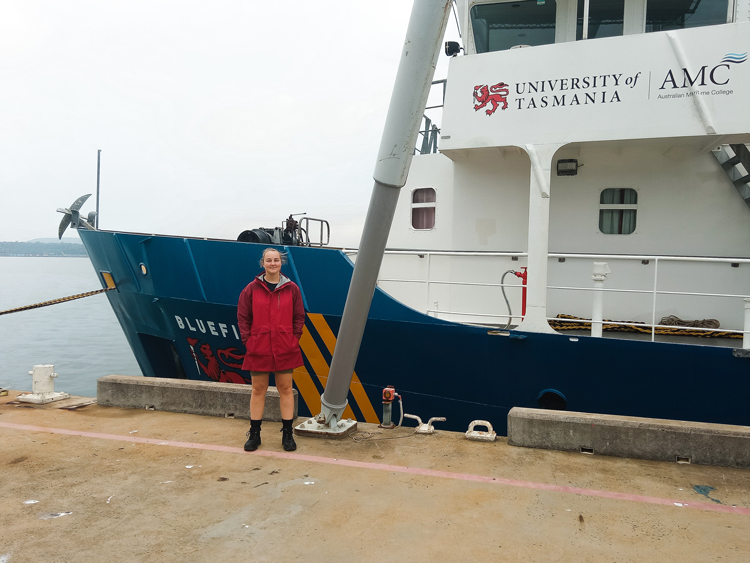
Alana Pols, Student, Ocean Engineering
The Bachelor of Maritime Engineering (Specialisation) (Honours) (Cooperative) is a 5-year program for high achieving students to combine a Bachelor of Maritime Engineering with 15-18 months of practical experience in your chosen specialisation. This is Australia's only specialist Maritime Engineering degree and the only program of its kind in the Southern Hemisphere. Throughout your course you’ll study through the Australian Maritime College (AMC), with access to some of the world's most advanced maritime training, research and testing facilities.
In your first two years, you'll build a strong foundation in engineering, mathematics, physical sciences and maritime engineering principles. You'll learn how engineering is applied to ships, offshore structures and marine environments through a combination of lectures, tutorials, laboratories and practical learning activities.
From your third year, you'll specialise in one of two areas:
Naval Architecture
Learn how vessels are designed, built and operated. You'll study the engineering behind everything from luxury yachts and ferries to submarines, naval vessels and commercial ships.
Ocean Engineering
Explore the design and operation of offshore, subsea and coastal structures. You'll study topics such as wave mechanics, offshore renewable energy, underwater technology and the engineering challenges of working in marine environments.
Throughout your degree, you'll apply what you've learned to real engineering problems and projects. In your final year, you'll complete major honours-level projects that allow you to investigate, design and solve complex maritime engineering challenges.
Study in Launceston
The on-campus components of this course are delivered in Launceston, a welcoming regional city known for its lifestyle, outdoor experiences and strong student community. You'll study at the Australian Maritime College based at the Newnham campus precinct where you'll have access to specialist maritime teaching and training facilities.
Find out more about living and studying in Launceston.
- 1 Solve complex technical problems using engineering techniques, tools, and resources through the application of science, technology, engineering and mathematics.
- 2 Apply systematic engineering design and analysis processes to solve complex maritime engineering problems.
- 3 Critically evaluate current developments, advanced technologies, and emerging issues to create innovative solutions for the maritime engineering industry.
- 4 Manage maritime engineering projects using systematic approaches, soft skills, and effective communication in the professional and lay domains
- 5 Practice the personal attributes of a professional engineer by implementing ethical and sustainable engineering practices and professional accountability.
Practical learning is embedded throughout your degree. You’ll have opportunities to participate in hands-on maritime projects and ship-based experiences that introduce you to marine operations and the unique challenges of engineering in offshore and deep-sea environments. You'll also work with specialist maritime facilities, testing equipment and training resources available through AMC.
Industry experience is built into your degree. A defining feature of this course is its Co-operative Education program.
You'll alternate periods of study with paid professional work placements, completing the equivalent of around one year of industry experience before graduation. Working under the supervision of professional engineers, you'll develop practical skills, build industry networks and explore different career pathways while you study. We work with industry to identify suitable Co-op placement opportunities, which are advertised directly to students. You can apply for positions that match your interests, with structured support from the Co-op team throughout the recruitment and placement process.
Your workplace learning is integrated throughout the degree:
- After Year 1: Engineering Practicum (Coxswain Course )
- After Year 2: Work Term 2A
- Beginning of Year 3: Work Term 2B
- After Year 3: Work Term 3
- During Year 4: Extended Work Term 4 placement
- Before Year 5: Co-operative Education Portfolio
The Bachelor of Maritime Engineering (Sepciation) (Honours) (Co-operative Education) is an externally accredited degree.
The following specialisations of this course are accredited by Engineers Australia:
- Naval Architecture
- Ocean Engineering
Completion of a specialisation may meet the requirements for membership of Engineers Australia. There may be additional requirements for membership beyond the completion of the specialisation.
For further membership requirements, please visit Engineers Australia website.
If you have any queries about the accreditation process, please contact us for further information.
Career outcomes

Tim Macdonald, AMC alumnus
More than 15,000 jobs are expected to be created in Australia as part of the continuous Naval Shipbuilding Program over the coming decades. Our graduates pursue successful careers in one of two specialist streams of Maritime Engineering:
Naval Architect
Design the most complex machines on Earth, from luxury yachts and submarines to the future of autonomous shipping and Australia’s next-generation naval fleet.
Ocean Engineer
Design, build, support, and maintain the vast range of structures and machines that make up the maritime industry.
There is international demand for qualified graduates in the following areas:
- Ship building
- Alternative energy
- Marine survey
- Statutory bodies
- Defence
- Industrial process and power generation sectors
Postgraduate study
If you successfully complete this course, you may be also be eligible to apply for a range of other postgraduate courses including graduate certificates and graduate diplomas and master's by coursework and research.
Course structure
The Bachelor of Maritime Engineering (Specialisation) (Honours) (Co-operative Education) requires the completion of 500 credit points comprising:
- 400 credit points of Core units
- 75 credit point Specialisation
- 25 credit points of Electives
The Core units are compulsory for all students and are the same set of units as completed by students enrolled in 24V1 Bachelor of Maritime Engineering (Specialisation) (Honours). Uniquely, the Co-operative Education program structure also incorporates the equivalent of one year of industry based work placements.
You will select your engineering Specialisation from the following: Naval Architecture or Ocean Engineering. 6 specialist units (75 credit points) will be completed across Years 3 and 4.
In the Elective component you can choose from any units marked as "Student Electives" which you meet the pre-requisites for, at any level, from across the university. To search for possible Elective units, use the Unit Search tool to search by the discipline that you are interested in.
Your electives can be used to add breadth to your degree, by exploring a variety of different subject areas from within or outside the College of Sciences and Engineering. Alternatively, you can deepen your engagement with specific subject areas, for example, by completing additional units in the same discipline as your major or related fields.
We have a team of Student Advisers available to help you structure your studies to meet your desired outcomes. For enrolment assistance please contact us via U Connect today.
This unit is an introduction to a range of concepts that are fundamental to understanding electrical theory. You will develop an understanding of electrical circuits and circuit analysis through workshops, tutorials, and laboratory work. The unit provides you with the…
Credit Points: 12.5
| Location | Study period | Attendance options | Available to | ||
|---|---|---|---|---|---|
| Launceston | Semester 2 |  |  |  | |
- Key:
- On-campus
 Off-Campus
- International students
- Domestic students
This unit introduces students to the use of materials in an engineering context. Students will learn the properties used to classify materials from an engineering perspective, and how these are determined. Students will apply this knowledge to characterise materials using…
Credit Points: 12.5
| Location | Study period | Attendance options | Available to | ||
|---|---|---|---|---|---|
| Launceston | Semester 2 | | | | |
- Key:
- On-campus
- Off-Campus
- International students
- Domestic students
In this unit you will develop knowledge and skills for solving problems in engineering dynamics based on fundamental theory developed using Newtonian Mechanics with an introductory focus on particle kinematics and kinetics. This leads to the development of problem solving…
Credit Points: 12.5
| Location | Study period | Attendance options | Available to | ||
|---|---|---|---|---|---|
| Launceston | Semester 2 | | | | |
- Key:
- On-campus
- Off-Campus
- International students
- Domestic students
This unit aims to develop student competency in analysing static equilibrium problems through the systematic application of rigid body mechanics principles. Students will examine objects at rest or in uniform motion, employing structured analytical approaches to solve engineering problems. Upon…
Credit Points: 12.5
| Location | Study period | Attendance options | Available to | ||
|---|---|---|---|---|---|
| Launceston | Semester 1 | | | | |
- Key:
- On-campus
- Off-Campus
- International students
- Domestic students
The unit is primarily designed for students to develop basic to intermediate computer-based skills to solve engineering problems using mathematical and programming techniques. The emphasis is on developing solutions and algorithms by building well structured and efficient computer programs and…
Credit Points: 12.5
| Location | Study period | Attendance options | Available to | ||
|---|---|---|---|---|---|
| Launceston | Semester 1 | | | | |
- Key:
- On-campus
- Off-Campus
- International students
- Domestic students
View all details for JEE158 Engineering Problem Solving and Data Analysis
This unit aims to introduce students to the professional practice of engineering (including ongoing learning, ethics and safety) and develops skills in technical communication, engineering drawings, engineering design process, and project management techniques. Students will apply this knowledge to work…
Credit Points: 12.5
| Location | Study period | Attendance options | Available to | ||
|---|---|---|---|---|---|
| Launceston | Semester 1 | | | | |
- Key:
- On-campus
- Off-Campus
- International students
- Domestic students
View all details for JEE159 Engineering Design and Communication
The applicability of calculus and linear algebra is so broad that fluency in it is essential for a successful career in a variety of areas including science and engineering. This unit is devoted to the conceptual and logical development of…
Credit Points: 12.5
| Location | Study period | Attendance options | Available to | ||
|---|---|---|---|---|---|
| Hobart | Semester 1 | | | | |
| Launceston | Semester 1 | | | | |
| Online | Semester 1 | | | | |
- Key:
- On-campus
- Off-Campus
- International students
- Domestic students
This unit is a continuation of KMA152, with emphasis on the application of single-variable calculus and linear algebra to problems in mathematics, the physical and biological sciences, economics, and engineering. Topics include complex numbers, linear equations and matrices, numerical integration…
Credit Points: 12.5
| Location | Study period | Attendance options | Available to | ||
|---|---|---|---|---|---|
| Hobart | Semester 2 | | | | |
| Launceston | Semester 2 | | | | |
| Online | Semester 2 | | | | |
- Key:
- On-campus
- Off-Campus
- International students
- Domestic students
This unit is an introduction to a range of concepts that are fundamental to understanding electrical theory. You will develop an understanding of electrical circuits and circuit analysis through workshops, tutorials, and laboratory work. The unit provides you with the…
Credit Points: 12.5
| Location | Study period | Attendance options | Available to | ||
|---|---|---|---|---|---|
| Launceston | Semester 2 | | | | |
- Key:
- On-campus
- Off-Campus
- International students
- Domestic students
In this unit you will develop practical skills that will assist you to communicate with technical staff and tradespeople in the maritime industry. You will apply a range of engineering techniques while gaining the necessary skills to safely and efficiently…
Credit Points: 12.5
This is the foundation unit in the study of structures. By applying the knowledge gained in Engineering Statics, the students are introduced to fundamental theories and techniques required to analyse the state of stress and strain in structural members subjected…
Credit Points: 12.5
| Location | Study period | Attendance options | Available to | ||
|---|---|---|---|---|---|
| Launceston | Semester 1 | | | | |
- Key:
- On-campus
- Off-Campus
- International students
- Domestic students
The design and analysis of engineering fluid systems and marine vehicles requires knowledge of the principles and behaviour of moving and stationary fluids. This unit provides students with knowledge and understanding of fluid flow phenomena via flow visualization, theory and…
Credit Points: 12.5
| Location | Study period | Attendance options | Available to | ||
|---|---|---|---|---|---|
| Launceston | Semester 2 | | | | |
- Key:
- On-campus
- Off-Campus
- International students
- Domestic students
Energy is one of the 21st century’s biggest engineering issues, and thermodynamics (the science of energy) will play a key role in understanding the energy needs. JEE223 Thermal Engineering is a foundation unit designed to introduce the laws and concepts…
Credit Points: 12.5
| Location | Study period | Attendance options | Available to | ||
|---|---|---|---|---|---|
| Launceston | Semester 2 | | | | |
- Key:
- On-campus
- Off-Campus
- International students
- Domestic students
This unit provides students with knowledge of the fundamental concepts of statical stability and trim of intact and damaged floating structures and the associated practical implications and applications within a regulated environment. This is a unit pivotal to an adequate…
Credit Points: 12.5
| Location | Study period | Attendance options | Available to | ||
|---|---|---|---|---|---|
| Launceston | Semester 2 | | | | |
| Online | Semester 2 | | | | |
- Key:
- On-campus
- Off-Campus
- International students
- Domestic students
This unit introduces the ocean environment and the role of maritime engineers in the design of maritime infrastructure. The unit covers essential elementary knowledge of marine sciences, types of marine crafts and maritime structures, marine systems, and ocean renewable energy…
Credit Points: 12.5
| Location | Study period | Attendance options | Available to | ||
|---|---|---|---|---|---|
| Launceston | Semester 1 | | | | |
| Online | Semester 1 | | | | |
- Key:
- On-campus
- Off-Campus
- International students
- Domestic students
View all details for JEE246 Introduction to Maritime Science, Engineering and Technology
This unit aims to introduce students to the fundamental knowledge and tools required for the analysis of oscillating systems within the maritime engineering field. Students will be required to perform calculations enabling them to model systems such as ocean waves…
Credit Points: 12.5
| Location | Study period | Attendance options | Available to | ||
|---|---|---|---|---|---|
| Launceston | Semester 1 | | | | |
- Key:
- On-campus
- Off-Campus
- International students
- Domestic students
Maritime Design and Production aims to develop students’ knowledge in the design and production of maritime infrastructure. Students will explore all stages of the project lifecycle from response to tender, design conception, manufacturing and delivery and finally decommissioning. Students will…
Credit Points: 12.5
| Location | Study period | Attendance options | Available to | ||
|---|---|---|---|---|---|
| Launceston | Semester 2 | | | | |
- Key:
- On-campus
- Off-Campus
- International students
- Domestic students
Maritime Systems aims to develop students’ understanding of the key systems on board maritime platforms. Students will learn to explain, predict performance and select components for integrated systems including powering systems, hydraulic systems, instrumentation and control systems, and emerging power…
Credit Points: 12.5
| Location | Study period | Attendance options | Available to | ||
|---|---|---|---|---|---|
| Launceston | Semester 1 | | | | |
- Key:
- On-campus
- Off-Campus
- International students
- Domestic students
All 5 work terms have a minimum requirement of 12 weeks engineering professional practice. Those work terms that back on to each other can be completed continuously with the same company. In fact, all work terms could be completed with…
Credit Points: 12.5
| Location | Study period | Attendance options | Available to | ||
|---|---|---|---|---|---|
| Launceston | Trimester | | | | |
- Key:
- On-campus
- Off-Campus
- International students
- Domestic students
All 5 work terms have a minimum requirement of 12 weeks engineering professional practice. Those work terms that back on to each other can be completed continuously with the same company. In fact, all work terms could be completed with…
Credit Points: 12.5
| Location | Study period | Attendance options | Available to | ||
|---|---|---|---|---|---|
| Launceston | Semester 1 | | | | |
- Key:
- On-campus
- Off-Campus
- International students
- Domestic students
Finite Element Analysis (JEE350) is an advanced unit that introduces the student to the theory and application of the Finite Element Method in engineering analysis and design. In addition to learning the theoretical bases of the finite element method the…
Credit Points: 12.5
| Location | Study period | Attendance options | Available to | ||
|---|---|---|---|---|---|
| Launceston | Semester 2 | | | | |
- Key:
- On-campus
- Off-Campus
- International students
- Domestic students
This unit facilitates translation of theory learned across a range of prior and concurrent subjects into practical application via hands-on projects conducted in the field. Additionally, students are engaged in marine operations which expose relevant issues unique to the maritime…
Credit Points: 12.5
| Location | Study period | Attendance options | Available to | ||
|---|---|---|---|---|---|
| Launceston | Semester 2 | | | | |
- Key:
- On-campus
- Off-Campus
- International students
- Domestic students
All 5 work terms have a minimum requirement of 12 weeks engineering professional practice. Those work terms that back on to each other can be completed continuously with the same company. In fact, all work terms could be completed with…
Credit Points: 12.5
| Location | Study period | Attendance options | Available to | ||
|---|---|---|---|---|---|
| Launceston | Trimester | | | | |
- Key:
- On-campus
- Off-Campus
- International students
- Domestic students
All 5 work terms have a minimum requirement of 12 weeks engineering professional practice. Those work terms that back on to each other can be completed continuously with the same company. In fact, all work terms could be completed with…
Credit Points: 25
| Location | Study period | Attendance options | Available to | ||
|---|---|---|---|---|---|
| Launceston | Semester 2 | | | | |
- Key:
- On-campus
- Off-Campus
- International students
- Domestic students
This is an advanced unit that introduces students to the linearised elastic analysis techniques required for the design of structural systems used in maritime engineering projects. Building upon the knowledge gained in previous structure-themed units, students are introduced to new…
Credit Points: 12.5
| Location | Study period | Attendance options | Available to | ||
|---|---|---|---|---|---|
| Launceston | Semester 1 | | | | |
- Key:
- On-campus
- Off-Campus
- International students
- Domestic students
All 5 work terms have a minimum requirement of 12 weeks engineering professional practice. Those work terms that back on to each other can be completed continuously with the same company. In fact, all work terms could be completed with…
Credit Points: 25
| Location | Study period | Attendance options | Available to | ||
|---|---|---|---|---|---|
| Launceston | Trimester | | | | |
- Key:
- On-campus
- Off-Campus
- International students
- Domestic students
Students develop, implement and carry out a research project under the supervision of at least one staff member from the National Centre for Maritime Engineering and Hydrodynamics or UTAS. The progress and outcomes of the research are assessed in the…
Credit Points: 12.5
| Location | Study period | Attendance options | Available to | ||
|---|---|---|---|---|---|
| Launceston | Semester 1 | | | | |
| Semester 2 | | | | ||
- Key:
- On-campus
- Off-Campus
- International students
- Domestic students
Students develop, implement and carry out a research project under the supervision of at least one staff member from the National Centre for Maritime Engineering and Hydrodynamics or UTAS. The progress and outcomes of the research are assessed in the…
Credit Points: 12.5
| Location | Study period | Attendance options | Available to | ||
|---|---|---|---|---|---|
| Launceston | Semester 1 | | | | |
| Semester 2 | | | | ||
- Key:
- On-campus
- Off-Campus
- International students
- Domestic students
This is the capstone design unit for the Bachelor of Maritime Engineering degree, catering to both the Naval Architecture and Ocean Engineering specialisations. Maritime engineering design involves developing complex solutions through the combined inputs of specialists from various engineering disciplines.…
Credit Points: 12.5
| Location | Study period | Attendance options | Available to | ||
|---|---|---|---|---|---|
| Launceston | Semester 1 | | | | |
- Key:
- On-campus
- Off-Campus
- International students
- Domestic students
This is the capstone design unit for the Bachelor of Maritime Engineering degree, catering to both the Naval Architecture and Ocean Engineering specialisations. Maritime engineering design involves developing complex solutions through the combined inputs of specialists from various engineering disciplines.…
Credit Points: 12.5
| Location | Study period | Attendance options | Available to | ||
|---|---|---|---|---|---|
| Launceston | Semester 2 | | | | |
- Key:
- On-campus
- Off-Campus
- International students
- Domestic students
The design and analysis of engineering fluid systems and marine vehicles require the prediction of the fluid behaviour and the interaction between the fluid and the system. This requires a good knowledge of thermo-fluid dynamic principles and the behaviour under…
Credit Points: 12.5
| Location | Study period | Attendance options | Available to | ||
|---|---|---|---|---|---|
| Launceston | Semester 1 | | | | |
| Online | Semester 1 | | | | |
- Key:
- On-campus
- Off-Campus
- International students
- Domestic students
View all details for JEE480 Applied Computational Fluid Dynamics
Administrative unit to be used for recording Honours grades and marks…
Credit Points: 0
| Location | Study period | Attendance options | Available to | ||
|---|---|---|---|---|---|
| Hobart | Semester 1 | | | | |
| Semester 2 | | | | ||
| Launceston | Semester 1 | | | | |
| Semester 2 | | | | ||
- Key:
- On-campus
- Off-Campus
- International students
- Domestic students
The Bachelor of Maritime Engineering (Hons)(Naval Architecture) prepares graduates for careers in the shipbuilding industry, designing and constructing luxury super yachts, sailing and power craft, destroyers and patrol boats for the defence industry, underwater vehicles and submarines, and big ocean cruise liners; the high-speed ferry industry; insurance sector; and marine consultancy firms. It is also an excellent gateway to a career in government in the areas of commercial shipping, transport policy and administration.
The purpose of the unit is to provide knowledge on ship seakeeping and ship manoeuvring. The details behind theoretical and experimental prediction methods are described and students use this information to predict and assess ship seakeeping and manoeuvring performance. Students…
Credit Points: 12.5
| Location | Study period | Attendance options | Available to | ||
|---|---|---|---|---|---|
| Launceston | Semester 2 | | | | |
- Key:
- On-campus
- Off-Campus
- International students
- Domestic students
To provide an understanding and working knowledge of resistance and propulsion of ships. Experimental and theoretical methods are covered with an emphasis on application to design. Students are shown the theory behind these methods and are required to demonstrate usage…
Credit Points: 12.5
| Location | Study period | Attendance options | Available to | ||
|---|---|---|---|---|---|
| Launceston | Semester 1 | | | | |
- Key:
- On-campus
- Off-Campus
- International students
- Domestic students
This unit exposes students to practical design issues and processes and facilitates development of conceptual, analytical and project-planning skills required for a preliminary level of ship design with an emphasis on the application of skills developed in previous units directly…
Credit Points: 12.5
| Location | Study period | Attendance options | Available to | ||
|---|---|---|---|---|---|
| Launceston | Semester 2 | | | | |
- Key:
- On-campus
- Off-Campus
- International students
- Domestic students
This unit covers the key elements and essential concepts of environmental forcings on offshore structures and vessels. Additionally, the unit helps students in developing and applying appropriate numerical and analysis methods relevant to engineering problems of structures at sea. The…
Credit Points: 12.5
| Location | Study period | Attendance options | Available to | ||
|---|---|---|---|---|---|
| Launceston | Semester 1 | | | | |
- Key:
- On-campus
- Off-Campus
- International students
- Domestic students
Advanced Ship Structures is an advanced and specialised unit aimed at furthering students’ knowledge and understanding of ship structures. By applying the knowledge gained in previous units such as Mechanics of Solids and Analysis of Machines & Structures and combining…
Credit Points: 12.5
| Location | Study period | Attendance options | Available to | ||
|---|---|---|---|---|---|
| Launceston | Semester 1 | | | | |
- Key:
- On-campus
- Off-Campus
- International students
- Domestic students
Underwater Vehicle Technology is an advanced and specialist unit aimed at developing the students’ knowledge and understanding of naval architecture theories, concepts and principles required for the design torpedo-shaped underwater vehicles. This particular shape is the classic hull form used…
Credit Points: 12.5
| Location | Study period | Attendance options | Available to | ||
|---|---|---|---|---|---|
| Launceston | Semester 2 | | | | |
- Key:
- On-campus
- Off-Campus
- International students
- Domestic students
The Bachelor of Maritime Engineering (Ocean Engineering) (Honours) prepares graduates for careers designing and managing the installation of offshore, subsea and coastal structures for the oil and gas industry, in particular, the offshore industry; the renewable energy industry; coastal and environmental engineering; marine consultancy firms; and ocean research organisations.
This advanced unit introduces students to industry-standard methods, codes, and practices for the loading, analysis, design, and construction of fixed steel and concrete offshore structures, as well as subsea systems and pipelines. The unit also covers key geotechnical engineering topics…
Credit Points: 12.5
| Location | Study period | Attendance options | Available to | ||
|---|---|---|---|---|---|
| Launceston | Semester 2 | | | | |
- Key:
- On-campus
- Off-Campus
- International students
- Domestic students
View all details for JEE320 Applied Offshore Structural Engineering
This is an advanced ocean engineering unit that introduces students to the complex hydrodynamic and structural challenges associated with floating structure design. Students will apply their knowledge of hydrostatics, environmental loading, and structural response to understand the engineering principles that…
Credit Points: 12.5
| Location | Study period | Attendance options | Available to | ||
|---|---|---|---|---|---|
| Launceston | Semester 1 | | | | |
- Key:
- On-campus
- Off-Campus
- International students
- Domestic students
View all details for JEE359 Design of Floating Offshore Structures
This unit covers the key elements and essential concepts of environmental forcings on offshore structures and vessels. Additionally, the unit helps students in developing and applying appropriate numerical and analysis methods relevant to engineering problems of structures at sea. The…
Credit Points: 12.5
| Location | Study period | Attendance options | Available to | ||
|---|---|---|---|---|---|
| Launceston | Semester 1 | | | | |
- Key:
- On-campus
- Off-Campus
- International students
- Domestic students
This unit focuses on the design of offshore energy infrastructure, exposing students to practical design considerations, issues, and processes. It consolidates and expands on knowledge in mooring system design, fixed and floating offshore structure design, ocean wave mechanics, and resource…
Credit Points: 12.5
| Location | Study period | Attendance options | Available to | ||
|---|---|---|---|---|---|
| Launceston | Semester 2 | | | | |
- Key:
- On-campus
- Off-Campus
- International students
- Domestic students
This is an advanced design unit of the Ocean Engineering specialisation that introduces the students to key concepts in coastal engineering. The unit extends and applies the concepts from hydrodynamics and marine structural engineering to the context of coastal-zone hydrodynamics,…
Credit Points: 12.5
| Location | Study period | Attendance options | Available to | ||
|---|---|---|---|---|---|
| Launceston | Semester 1 | | | | |
- Key:
- On-campus
- Off-Campus
- International students
- Domestic students
View all details for JEE402 Design of Coastal Engineering Structures
Underwater Vehicle Technology is an advanced and specialist unit aimed at developing the students’ knowledge and understanding of naval architecture theories, concepts and principles required for the design torpedo-shaped underwater vehicles. This particular shape is the classic hull form used…
Credit Points: 12.5
| Location | Study period | Attendance options | Available to | ||
|---|---|---|---|---|---|
| Launceston | Semester 2 | | | | |
- Key:
- On-campus
- Off-Campus
- International students
- Domestic students
Entry requirements
We encourage you to apply for the courses you most want to study. If you are not eligible to enter your chosen course right now, the University’s admissions team will work with you to find the best pathway option.
Enquire online for more advice on the application process and the available pathways to enrol and study at the University of Tasmania.
Schools Recommendation Program
Australian year 12 students can apply for this course via our Schools Recommendation Program (SRP). Rather than an ATAR, your application is based on a recommendation by your school teachers. This can factor in your year 11 results, an assessment of your capabilities, and other considerations.
Through the SRP, you can receive and accept an offer prior to completing year 12. You will still need to finish your year 12 studies – including any exams – to commence your studies. In addition, this course requires you to pass specific pre-requisite subjects in Year 12 (or equivalent), see below for details.
If you don’t receive an offer for this course through the Schools Recommendation Program, you will be re-assessed for a higher preference offer once your ATAR is released.
Domestic applicants who recently completed secondary education
Applicants are ranked by ATAR and offers are made based on the number of places available. In 2026, the lowest ATAR to receive an offer into this course was 86.7. The lowest ATAR to receive an offer may change from year to year based on the number of applications we receive.
Applicants who have recently completed senior secondary studies but have not received an ATAR may still be eligible for admission. We will consider your individual subject results on a case-by-case basis when we assess your application.
Domestic applicants with higher education study
To be eligible for an offer, applicants must have:
- Partially completed an undergraduate course at Diploma level or higher (or equivalent). Applicants must have completed at least two units of study (equivalent to 25 University of Tasmania credit points). If an applicant has failed any units, the application may be subject to further review before an offer is made; OR
- Completed the University of Tasmania University Preparation Program (or an equivalent qualification offered by an Australian university).
Domestic applicants with VET / TAFE study
To be eligible for an offer, applicants must have completed a Certificate IV (or equivalent) in any discipline.
Domestic applicants with work and life experience
Applicants without senior secondary, tertiary or VET / TAFE study can complete a personal competency statement.
Applicants may be eligible for an offer if they have relevant work and/or life experiences which demonstrate a capacity to succeed in this course.
Subject Prerequisites
These prerequisites apply to students from all educational backgrounds.
To be an eligible for an offer, you must have completed studies or have experience equivalent to a satisfactory achievement in the following Tasmanian Senior Secondary subjects:
- Mathematics Methods (MTM415117) or equivalent
- Physical Sciences (PSC315118) or equivalent (equivalency includes CHM415115 Chemistry OR PHY415115 Physics)
You can enquire online for information on interstate and international equivalents to the Tasmanian senior secondary subject above. If you need assistance to meet the prerequisites, we offer foundation units that you can complete before you start your course.
SPECIAL CONSIDERATION
We believe university education should be an option for everyone, no matter your background. If your ability to access or participate in education has been affected by circumstances beyond your control, you can apply for special consideration as part of your application. We will consider a range of factors, including economic hardship, a serious medical condition, or disability.
We can only approve applications for special consideration if we are confident that you have the necessary skills and knowledge to succeed in your studies. If your application is not approved, the University admissions team will work with you to find the best alternative pathway to your chosen course. Special consideration is not available for international applicants.
COURSE PARTICIPATION REQUIREMENTS
This course includes compulsory Work Integrated Learning (professional experience placements). In order to participate in placements, all students must:
- Complete a Safe to Practice Agreement declaring they have the medical, physical or psychological capacity to safely participate in professional experience practice.
How to apply for a credit transfer
Applications for credit can be made in your course application. Find out more information about how to apply for a credit transfer/advanced standing at Recognition of Prior Learning.
Talk to us on 13 8827 or enquire online about your credit transfer.
Articulation from previous course versions: students who have commenced a pre-2021 Bachelor of Engineering course at the Australian Maritime College will be eligible for full credit for all units successfully completed under the previous course version (towards the Bachelor of Engineering (Specialisation) (Honours)(Co-operative Education)), provided that the units were completed no more than 10 years prior to the year of graduation from the new award.
Articulation to the SoE BEng program: students may transfer to this course after completing the first two semesters of P4D in Hobart but they will need to enrol in JEE139 for the summer semester following year 1. Students may transfer to P4D in Hobart after completing one year of this course in Launceston.
Articulation to/from Co-operative Education program: students may articulate between the BMarEng(Spec)(Hons) and the BMarEng(Spec)(Hons)(Co-op) courses with full credit, subject to meeting the applicable admission requirements for course transfer.
Articulation from other, related courses: students who have commenced a Bachelor of Engineering (Specialisation) (Honours) course or similar at the University of Tasmania or at another institution may receive up to a maximum of 2 years (200 credit points) of advanced standing towards the BMarEng(Spec)(Hons)(Co-op), subject to the approval of the Course Coordinator.
Detailed admissions information and advice for all undergraduate courses, including comprehensive, course-level student profiles, is available from UTAS Admissions.
Fees & scholarships
Domestic students
Commonwealth supported places (CSP) are available for this course. For eligible domestic students, this means your fees will be subsidised by the Australian Government. You’ll only need to pay the student contribution amount for each unit you study within the course.
Commonwealth Supported Place indicative annual fee: $8,336
How is this calculated?
This is an estimate. The calculation is based on the average full-time enrolment for this course in 2026. All figures are indicative only for 2027. Actual tuition fees will depend on specific unit enrolment, and are subject to annual increases each year. You can find the complete fee details for each unit of study on the individual unit pages. The units for this course are found in the course structure section of this page.
These figures do not include other costs such as the Student Services and Amenities Fee (SSAF). For further information, please visit Scholarships, fees and costs.
HECS-HELP loans
You may be able to defer payment of the student contribution amount by accessing a HECS-HELP loan from the Government. If eligible, you’ll only have to pay your tuition fees once you start earning above a specific amount.
Further information on student loans and a CSP eligibility checker can be found at Australian Government Study Assist.
Domestic scholarships
Scholarships for domestic students
Each year, the University offers more than 900 awards to students from all walks of life, including: those who have achieved high academic results, those from low socio-economic backgrounds, students with sporting ability, students undertaking overseas study, and students with a disability.
For information on all scholarships available at the University of Tasmania, please refer to scholarships.
Applications for most awards commencing in Semester 1 open at the beginning of August and close strictly on 31 October in the year prior to study.
Scholarships for international students
There are a huge range of scholarships, bursaries and fee discounts available for international students studying at the University of Tasmania. For more information refer to International Scholarships.


Share this page
How can we help?
Do you have any questions about choosing a course or applying? Get in touch.