

Overview (2027)

Key Information


Duration
Minimum 2 years, up to a maximum of 5 years.


Location
 CRICOS: 116316E
Duration
Minimum 2 years, up to a maximum of 5 years.
Location
Nathan Kilah
Associate Head, Learning and Teaching/Senior Lecturer
Chemistry
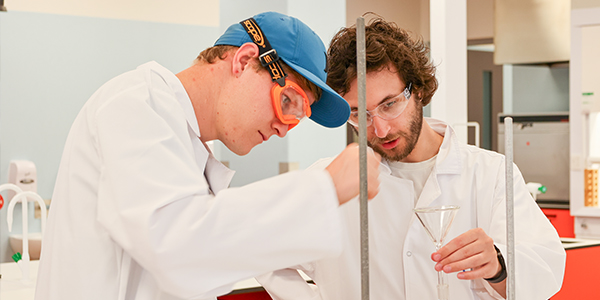
The Master of Chemistry is designed to help you gain advanced skills and knowledge for success in a wide range of chemistry-related careers. Whether you want to specialise in a new area or update your qualifications, this course provides a strong foundation for your future.
You will learn in a world-class research environment, guided by experts in the field. The course includes a research thesis, helping you develop excellent communication skills and practical experience for solving real-world problems. Chemistry plays a vital role in industries such as environmental protection, advanced manufacturing, and pharmaceuticals, and this course will prepare you to make an impact.
Graduates will be eligible for professional membership of the Royal Australian Chemical Institute and can also explore pathways to a PhD. This course opens doors to exciting opportunities in Australia and globally.
You can specialise in one of two streams:
| Stream | Semester 1 | Semester 2 |
|---|---|---|
| Synthesis and Materials Science | ✓ | ✗ |
| Analytical and Environment | ✗ | ✓ |
Watch our course information webinar
Thinking of studying this course and want to learn more? This webinar explores course structures, career opportunities, and the student experience to support your study journey.
- 1 Evaluate and interpret complex problems in a specialised area of chemistry
- 2 Demonstrate technical proficiency and professional practice, adhering to regulatory frameworks in a laboratory or industry context
- 3 Design and implement a research project in a specialized area of chemistry
- 4 Analyse and communicate scientific results, articulating arguments and conclusions, following recognised scientific standards.
The Master of Chemistry provides extensive opportunities for hands-on learning, ensuring you graduate with the practical experience needed to excel in your field. The course is divided into three distinctive phases -Transition, Mastery, and Capstone - each designed to build upon the last, providing comprehensive training in experimental skills and a deep understanding of chemistry's role in addressing current and future challenges.
During the Mastery phase, you'll undertake the Practice of Chemistry, where theory meets real-world application. This phase focuses on developing your ability to solve practical problems while working with the latest advancements and technologies in the field. You will:
- Tackle real-world challenges and apply cutting-edge chemistry techniques
- Enhance your problem-solving abilities through practical applications
- Gain a strong understanding of regulatory frameworks for chemical safety and handling in workplaces
- Develop essential skills in project design, safety assessment, and data collection using state-of-the-art facilities and instruments
- Build your research expertise and technical proficiency
- Hone your ability to communicate scientific findings effectively
In this course, you will gain valuable experience by being embedded within research groups, where you will operate as a professional scientist for a significant part of your studies. This hands-on approach provides an authentic learning environment and helps you develop essential workplace skills, including:
- Time management
- Teamwork
- Communication
- Social skills
- Working safely
- Working ethically
- Problem solving
These skills are crucial for your professional success.
Not professionally accredited.
Career outcomes

Nguyen Thi Duyen
Master of Applied Science (now the Master of Chemistry) graduate
As a graduate of the Master of Chemistry, you will be highly sought after by industry and research institutions. This degree provides you with a direct pathway to roles as a research scientist or prepares you for advanced research opportunities such as a PhD.
With this qualification, you’ll be ready to take on exciting and impactful roles, such as:
- Designing therapeutic agents to treat diseases.
- Developing renewable materials to replace fossil fuels.
- Creating innovative analytical methods for health and environmental monitoring.
Whether you aspire to make a difference in industry or lead ground-breaking research, this course equips you with the knowledge, skills, and experience to achieve your goals.
Course structure
The Master of Chemistry is a two-year (4 semester) course which comprises 3 distinct components to support the student experience.
-
Phase 1 (50 credit points) consists of either the Synthesis and Materials Science Stream (KRA521, KRA531, KRA541 and KRA542) or the Analytical and Environment Chemistry Stream (KRA521, KRA532, KRA540 and KRA544). These units provide the theoretical knowledge and techniques in preparation for the advanced-level units and the research component.
-
Phase 2 (100 credit points) consists of advanced units (KRA706, KRA707, KRA711, KRA712 and KRA713) focusing on relevant problems and recent advances in Chemical Sciences to extend theoretical knowledge and experimental skills including project design, assessment of safety and safe work practices in a chemical laboratory, and data collection using advanced and state-of-the-art facilities and instrumentation.
-
Phase 3 (50 credit points) consists of the research thesis (KRA708 and KRA709). The research component culminates in a thesis in which the data is assembled, critiqued, and formulated to defend the outcomes.
Important Note: Students who undertake the Synthesis and Materials Science stream will commence in Semester 1 and those who undertake the Analytical and Environment Chemistry stream will commence in Semester 2.
This unit consolidates theoretical and practical skills required for the study of chemistry at a Masters level. Students will gain hands-on experience through a number of synthetic and analytical laboratory experiments, and will gain familiarity with risk assessment procedures, glassware…
Credit Points: 12.5
| Location | Study period | Attendance options | Available to | ||
|---|---|---|---|---|---|
| Hobart | Semester 1 |  |  |  | |
| Semester 2 | | | | ||
- Key:
- On-campus
 Off-Campus
- International students
- Domestic students
View all details for KRA521 Laboratory Techniques and Scientific Reporting
In this unit, students conduct a comprehensive analysis and synthesis of literature within a specific Chemistry domain. Under the guidance of an academic supervisor, students will hone their skills in discerning pivotal concepts, trends, and evolutions in their chosen field.…
Credit Points: 12.5
| Location | Study period | Attendance options | Available to | ||
|---|---|---|---|---|---|
| Hobart | Semester 1 | | | | |
| Semester 2 | | | | ||
- Key:
- On-campus
- Off-Campus
- International students
- Domestic students
In this unit you will learn the practice of implementing a research project. This involves assessing the risks, resources, and timelines required to undertake a research project in either synthetic/materials OR analytical/environmental chemistry. You will implement the project in the…
Credit Points: 12.5
| Location | Study period | Attendance options | Available to | ||
|---|---|---|---|---|---|
| Hobart | Semester 1 | | | | |
| Semester 2 | | | | ||
- Key:
- On-campus
- Off-Campus
- International students
- Domestic students
View all details for KRA712 Research Methods Laboratory Practice
In this unit, as part of the Masters of Chemistry's theoretical component, you will identify challenges in the chemistry domain, specifically within synthetic or analytical/environmental chemistry, and devise a comprehensive research plan. The course emphasizes regular oral presentations detailing progress,…
Credit Points: 25
| Location | Study period | Attendance options | Available to | ||
|---|---|---|---|---|---|
| Hobart | Semester 1 | | | | |
| Semester 2 | | | | ||
- Key:
- On-campus
- Off-Campus
- International students
- Domestic students
View all details for KRA713 Addressing Problems in Chemistry: Planning and Presentation
You will build on your knowledge introductory chemistry, including organic spectroscopy for the structural identification of organic and inorganic molecules, and the fundamental reactions and concepts central to chemistry for synthesis. Other topics include the synthesis and properties of organic…
Credit Points: 12.5
| Location | Study period | Attendance options | Available to | ||
|---|---|---|---|---|---|
| Hobart | Semester 1 | | | | |
- Key:
- On-campus
- Off-Campus
- International students
- Domestic students
This unit builds on a basic understanding of organic chemistry and chemical reactivity and introduces advanced chemical reactions and the concept of rational synthetic design. The unit also highlights the key reactions in the synthesis of biological molecules and provides…
Credit Points: 12.5
| Location | Study period | Attendance options | Available to | ||
|---|---|---|---|---|---|
| Hobart | Semester 1 | | | | |
- Key:
- On-campus
- Off-Campus
- International students
- Domestic students
View all details for KRA541 Organic and Bioorganic Chemistry
You will build upon the foundations of inorganic chemistry and be introduced to more advanced concepts and applications. The topics will include bonding and structure and how this influences chemical reactivity. You will also explore how this understanding is applied…
Credit Points: 12.5
| Location | Study period | Attendance options | Available to | ||
|---|---|---|---|---|---|
| Hobart | Semester 2 | | | | |
- Key:
- On-campus
- Off-Campus
- International students
- Domestic students
View all details for KRA542 Catalysis and Advanced Inorganic Chemistry
This unit builds on general Chemistry knowledge to consolidate the theoretical and practical framework required by students for the Mastery component of the Master of Chemistry and consists of topics in Physical Chemistry and Analytical Chemistry. The Physical Chemistry module…
Credit Points: 12.5
| Location | Study period | Attendance options | Available to | ||
|---|---|---|---|---|---|
| Hobart | Semester 2 | | | | |
- Key:
- On-campus
- Off-Campus
- International students
- Domestic students
View all details for KRA532 Physical and Analytical Chemistry
Environmental Chemistry and Monitoring utilises the diversity of examples of environmental chemistry in natural, urban and industrial environments within Tasmania to develop an understanding of the sources and fate of chemical contaminants in the environment, and an understanding of the…
Credit Points: 12.5
| Location | Study period | Attendance options | Available to | ||
|---|---|---|---|---|---|
| Hobart | Semester 1 | | | | |
- Key:
- On-campus
- Off-Campus
- International students
- Domestic students
View all details for KRA540 Environmental Chemistry and Monitoring
The Advanced Analytical Techniques unit is a specialised module within the broader field of analytical chemistry, designed to immerse students in cutting-edge techniques and applications for qualitative and quantitative analysis. Techniques that will be covered have applications including ensuring…
Credit Points: 12.5
| Location | Study period | Attendance options | Available to | ||
|---|---|---|---|---|---|
| Hobart | Semester 2 | | | | |
- Key:
- On-campus
- Off-Campus
- International students
- Domestic students
You will design a research project with an academic supervisor and carry out the day-to-day implementation of the project including assessment of safety and collection of data. KRA707 (Chemistry Research Analysis and Presentation) is a co-requisite with this unit. The…
Credit Points: 25
| Location | Study period | Attendance options | Available to | ||
|---|---|---|---|---|---|
| Hobart | Semester 1 | | | | |
| Semester 2 | | | | ||
- Key:
- On-campus
- Off-Campus
- International students
- Domestic students
View all details for KRA704 Chemistry Research Design and Planning
You will collate and analyse the data generated in KRA706 (Chemistry Research Design and Planning) which is a co-requisite with this unit. You will also advance their oral communication skills by preparing and presenting preliminary and final research presentations to…
Credit Points: 25
| Location | Study period | Attendance options | Available to | ||
|---|---|---|---|---|---|
| Hobart | Semester 1 | | | | |
| Semester 2 | | | | ||
- Key:
- On-campus
- Off-Campus
- International students
- Domestic students
View all details for KRA705 Chemistry Research Analysis and Presentation
This unit and KRA709 are the thesis components of the Master of Chemistry. In this unit, as part of the thesis segment for the Master of Chemistry, students will craft a research thesis built upon the experimental findings and analyses…
Credit Points: 25
| Location | Study period | Attendance options | Available to | ||
|---|---|---|---|---|---|
| Hobart | Semester 1 | | | | |
| Semester 2 | | | | ||
- Key:
- On-campus
- Off-Campus
- International students
- Domestic students
This unit and KRA708 are the thesis components of the Master of Chemistry. In this unit, as part of the thesis segment for the Master of Chemistry, students will craft a research thesis built upon the experimental findings and analyses…
Credit Points: 25
| Location | Study period | Attendance options | Available to | ||
|---|---|---|---|---|---|
| Hobart | Semester 1 | | | | |
| Semester 2 | | | | ||
- Key:
- On-campus
- Off-Campus
- International students
- Domestic students
Entry requirements
Bachelor of Science (or equivalent course) with at least a minor in Chemistry or equivalent and an average >65% for the chemistry units.
Admission to most postgraduate coursework courses at the University of Tasmania requires qualifications equivalent to an Australian bachelor degree. Applicants must achieve the required grade in their qualifying studies, meet any prerequisite subjects, and meet English language requirements to be eligible for an offer.
English Language Requirements
For students who do not meet the English Language Requirement through citizenship or prior studies in English in an approved country, evidence of an approved English language test completed within the last 2 years must be provided. See the English Language Requirements page for more information.
English Language Requirements are: IELTS (Academic) 6.0 (no individual band less than 6.0) or equivalent
Course Specific Requirements
Bachelor of Science (or equivalent course) with at least a minor in Chemistry or equivalent and an average >65% for the chemistry units.
Applications for credit can be made in your course application. Find out more information about how to apply for a credit transfer/advanced standing at Recognition of Prior Learning.
The Master of Chemistry course articulates to the University’s Higher Research Degree programs including Master of Research and Doctor of Philosophy (PhD).
Alternate entry pathways will be considered by the course coordinator on a case by case basis. Examples may include documented employment or practice in the discipline or related sub-discipline.
Fees & scholarships
Domestic students
Commonwealth supported places (CSP) are available for this course. For eligible domestic students, this means your fees will be subsidised by the Australian Government. You’ll only need to pay the student contribution amount for each unit you study within the course.
Commonwealth Supported Place indicative annual fee: $9,536
How is this calculated?
This is an estimate. The calculation is based on the average full-time enrolment for this course in 2026. All figures are indicative only for 2027. Actual tuition fees will depend on specific unit enrolment, and are subject to annual increases each year. You can find the complete fee details for each unit of study on the individual unit pages. The units for this course are found in the course structure section of this page.
These figures do not include other costs such as the Student Services and Amenities Fee (SSAF). For further information, please visit Scholarships, fees and costs.
HECS-HELP loans
You may be able to defer payment of the student contribution amount by accessing a HECS-HELP loan from the Government. If eligible, you’ll only have to pay your tuition fees once you start earning above a specific amount.
Further information on student loans and a CSP eligibility checker can be found at Australian Government Study Assist.
An important note on Youth Allowance and Austudy
The Department of Social Services has approved some accredited and professionally-oriented master’s courses for student payments through Youth Allowance or Austudy. This means if you enrol in one of these courses, you may be eligible for student payments. However, this is not the case for all master’s courses. Please visit Scholarships, fees and costs for further information.
International students
2027 annual international student tuition fee: $44,950 AUD
The standard year of study for this course is 100 credit points.
Indicative total tuition fee for international students: $ 92,148 AUD.
This total tuition fee is indicative only. Please visit fees and costs for further information on how this is calculated.
International students are charged the Student Services and Amenities Fee but this fee is incorporated in the annual rate. International students do not have to make any additional SSAF payments.
Domestic scholarships
For information on general scholarships available at the University of Tasmania, please visit the scholarships website.
International scholarships
The University of Tasmania offers a range of scholarships for full fee-paying international students, designed to recognise academic merit and support access to university study.
For many of our international scholarships you will be automatically assessed when you submit your International Student Application, meaning no separate scholarship application is required. Some scholarships may require additional application steps. Explore our International Scholarships to learn more about available opportunities and application requirements.


Share this page
How can we help?
Do you have any questions about choosing a course or applying? Get in touch.