

Overview (2027)

Key Information


Duration
Minimum 3 years, up to a maximum of 7 years.


Location
 CRICOS: 113032H
Duration
Minimum 3 years, up to a maximum of 7 years.
Location
By understanding the issues facing our planet, you can help build a better future.
There is no better place to study natural environments and conservation than Tasmania. Our state is a living laboratory, with approximately 23% of Tasmania recognised as world heritage, and 42% as protected areas, accessible from our campus. Your studies will also connect you to the rich culture of the conservation movement in Tasmania.
Understanding the connections between nature and human society is vital for informing the management, protection, and use of the natural environment. You’ll learn to think critically and creatively across disciplines. As a graduate, you’ll fight to protect and heal our planet.
Online study
The Bachelor of Natural Environments and Conservation can be studied predominantly online, which gives you the flexibility to learn in a way that suits your lifestyle. You can join lectures and practical classes live via Zoom or study in your own time. Most of the course can be completed from wherever you live.
There are three units with compulsory face to face activities and these require a short trip to Tasmania, usually for up to ten days at a time. Many students see this as a chance to explore Tasmania’s unique environments while gaining hands on field experience that is difficult to replicate online. These units are KGA213 at the end of first year, KGA331 at the end of second year and KGA318 at the end of third year. You may also attend the optional camp, or complete the mandatory online activities for KGA327. For further information, please see the unit descriptions below or contact the course coordinator.
Catalyst Program
Want to combine your degree with overseas trips, summer research programs, scholarships and special events? Our Catalyst Program offers domestic high achieving school leavers all this and more.
All domestic students with an ATAR of 90 or greater, enrolled in a range of STEM courses will be awarded a $3,000 Catalyst Scholarship. Across the program students can access scholarships of up to $14,500 in value, and gain experience that will make you stand out in your chosen field. Learn more about the Catalyst Program
Double degrees
This degree can be combined with another degree to form a double degree. Study what you want, explore your options and find out how you can accelerate your career.
The Bachelor of Natural Environments and Conservation can be taken as a vertical double degree with the Master of Protected Area Conservation. This option provides a clear four year pathway to completing both an undergraduate and postgraduate qualification, building strong scientific knowledge alongside advanced skills to manage and conserve natural places. You can find more details about this option under the Course structure heading further down the page.
Watch our course information webinar
Thinking of studying this course and want to learn more? This webinar explores course structures, career opportunities, and the student experience to support your study journey.
Ready to explore your study options?
Book an online one-on-one appointment with our course coordinator to discuss any course-related questions and explore how the Bachelor of Natural Environments and Conservation can support your study and career goals.
For current student enrolment questions and advice contact UConnect.
- 1 Gather, synthesise and critically evaluate information on natural environments and their relationships with people.
- 2 Explain the physical geography, politics and management of natural environments to contribute to political and social discourse.
- 3 Apply spatial, scientific and social science techniques and tools in keeping with relevant professional standards to answer questions related to the conservation and exploitation of natural environments.
- 4 Disseminate information and concepts about natural environments with other professionals and the public.
- 5 Produce and critique environmental assessments and natural environment management plans to improve ways people interact with the environment.
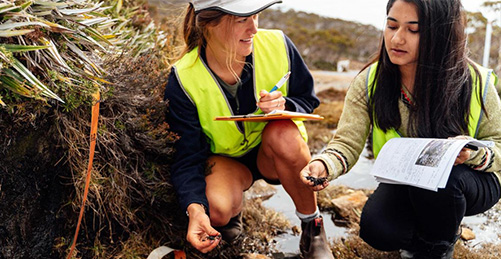
Your study experience will be a blend of classroom, laboratory and in-the-field learning in Tasmania's inspiring landscapes.
With World Heritage areas on our doorstep, we offer experiences that are generally unavailable at other Australian universities. Explore Tasmania's distinctive island environments, such as Bruny Island, through field-based experiences. These begin as early as week 3 of your first year and continue throughout your studies.
Some of the world's wildest and most outstanding natural environments are within an hour of the campus. We can access marine, coastal, heathland, wetland, grassland, woodland, dry eucalypt, wet eucalypt, and rainforest environments, as well as urban nature.
Our world-class teaching staff bring their cutting edge findings and examples to your lessons. Not just in the laboratory and classroom but outside, doing real-world tasks such as environment management plans and impact assessments.
Catalyst Program and Dean's Summer Research Scholarship
The Catalyst Program is available to high achieving domestic high school leavers studying a STEM course. It combines your Bachelor degree with scholarships, extracurricular experiences, special events, and networking opportunities. As a Catalyst scholarship recipient, you can participate in the Dean’s Summer Research Scholarship (DSRS) three times throughout your degree, with up to $9,000 in scholarships. Non-Catalyst students may also undertake the DSRS with a scholarship payment of $2,000 per experience.
As a Bachelor of Science student, you can take advantage of additional benefits such as access to work-integrated learning opportunities or research projects. Learn more about the Catalyst Program.
Become a Student Ambassador
Improve your communication, teamwork and leadership skills, meet new people, inspire and help others, and developing lasting friendships and networks as a student ambassador. Our ambassadors proudly represent the University throughout Tasmania in schools, at University and community events, and support a range of recruitment and engagement activities. Though the Student Ambassador Program or STEM Outreach Team you will have many opportunities for training and professional development, experience in real-world community engagement and outreach, networking, and public speaking, plus end up with a key point of distinction on your CV.
Study overseas at one of our partner institutions
Our international exchange program offers opportunities to study at universities around the world, and it counts towards your degree. Exchange can allow you to have an affordable educational and cultural experience in a foreign country for a semester, or a full year. To facilitate this, we offer a range of scholarships and financial assistance. You may also be eligible for OS-HELP Loans or scholarship funding to assist with their airfares, accommodation and other expenses.
Units in this degree, including KGA331 Fire, Weeds and Ferals: Conserving Nature in Protected Areas and KGA381 Environmental Impact Assessment involve you working with teams of students, undertaking intensive field work, and producing natural environment management plans. These plans are often utilised by the owners and managers of the land on which you are assessing, providing direct benefit to the environment and community while you study.
Career outcomes
Gemma Rushton
Bachelor of Natural Environment and Wilderness (now Natural Environment and Conservation)
There are endless career opportunities across government, private and not-for-profit industries. These include eco-tourism, natural area management, protection and interpretation, emergency management and planning, ecosystem restoration and natural resource management, and education. Here are some of the many exciting career paths you can follow.
- Plan sustainable cities
Collaborate across multiple professions, such as surveying, planning and management, to create healthy urban environments where we tackle issues such as bushfire, biodiversity and pollution in an informed way.
- Manage protected areas
If you have a passion for the natural world, you can seek a career in parks and protected areas around the worldwide You can supervise tourism and research visits, collaborate on conservation efforts, and help protect biodiversity.
- Become an environmental scientist
Follow a passion for science in areas such as biology, chemistry and ecology for a career that works to create solutions to some of the most vital challenges facing society. These include environmental and natural resource management, pollution monitoring, and environmental policy.
- Conservation and resource management
Natural resources used for human production and activity, such as water and soil, or environments like wetlands, forests and grasslands, must be carefully monitored, restored and managed by qualified professionals.
Postgraduate study
After successfully completing this course, you may be eligible to apply for a range of other postgraduate courses including Graduate Certificates and Graduate Diplomas and Masters by coursework and research. The most relevant are the Master of Planning and Master of Protected Area Conservation.
Course structure
The Bachelor of Natural Environments and Conservation requires the completion of 300 credit points comprising:
- 100 credit point Major
- 100 credit points of Core units
- 100 credit points of Elective units
The major in Natural Environment Management and the core units ensure both a breadth and depth of relevant knowledge
In your Elective component you can choose from any units marked as "Student Electives" which you meet the pre-requisites for, at any level, from across the university.
Your electives can be used to add breadth to your degree, by exploring a variety of different subject areas from within or outside the College of Sciences and Engineering. Alternatively, you can deepen your engagement with specific subject areas, for example, by completing additional units in the same discipline as your major or related fields.
You can also use this space to complete an optional second major which may be (i) a sustainability major, or (ii) *another major from across the institution, noting some exclusions apply. (*to enrol in a major outside your discipline, please contact U.Connect).
For help on how to find and choose your Elective units, see What are Elective units?
A course planner has been provided (see list to the right) which gives you a visual representation of your course and will help you plan which units to enrol in and when. For course planners from previous years, refer to the handbook entry for that year.
If you have any questions talk to U Connect today.
This major provides graduates with the knowledge and skills to gain employment in a wide variety of sectors related to the natural environment and wild country. Through guided study, authentic experience and practice it enables students to understand the reciprocal relationships between people and wild nature and ways in which wild nature can be managed and interpreted by people.
KGA171 Global Geographies of Change introduces you to how geography helps us understand today’s world. The unit explores key issues such as climate change, natural hazards, vulnerability, sustainability, population, development, and territory. You will learn how people and environments interact,…
Credit Points: 12.5
| Location | Study period | Attendance options | Available to | ||
|---|---|---|---|---|---|
| Hobart | Semester 1 |  |  |  | |
| Online | Semester 1 |  | | | |
- Key:
- On-campus
- Off-Campus
- International students
- Domestic students
This introductory unit develops your knowledge of how people depend on nature, and how increasingly the conservation of nature depends on people. We will explore these relationships through a values lens: how nature is important for its own sake, how natural…
Credit Points: 12.5
| Location | Study period | Attendance options | Available to | ||
|---|---|---|---|---|---|
| Hobart | Semester 2 | | | | |
| Online | Semester 2 | | | | |
- Key:
- On-campus
- Off-Campus
- International students
- Domestic students
The physical and living aspects of the global environment interact to produce the extraordinary variety of landscapes, ecosystems and species that occupy this planet. This unit highlights the interplay and conservation of controlling processes so that they continue to maintain…
Credit Points: 12.5
| Location | Study period | Attendance options | Available to | ||
|---|---|---|---|---|---|
| Hobart | Semester 1 | | | | |
| Online | Semester 1 | | | | |
- Key:
- On-campus
- Off-Campus
- International students
- Domestic students
Society needs professional environmental managers who have the knowledge and skills to effectively tackle problems of sustainable resource use, climate change and biodiversity conservation. Environmental managers also play an important role in helping communities identify and move towards sustainable and…
Credit Points: 12.5
| Location | Study period | Attendance options | Available to | ||
|---|---|---|---|---|---|
| Hobart | Semester 2 | | | | |
| Online | Semester 2 | | | | |
| Shanghai Ocean University | Shanghai Semester 1 | | | ||
- Key:
- On-campus
- Off-Campus
- International students
- Domestic students
In a globalised economy and changing climate, ecological health, individual well-being, social cohesion are in decline. More people and more places are experiencing hardship, with those in the Global South (the majority world) and in disadvantaged parts of the Global…
Credit Points: 12.5
| Location | Study period | Attendance options | Available to | ||
|---|---|---|---|---|---|
| Hobart | Semester 2 | | | | |
| Online | Semester 2 | | | | |
- Key:
- On-campus
- Off-Campus
- International students
- Domestic students
View all details for KGA308 Geographies of Collapse and Resilience
Human-induced climate change is arguably the most serious problem currently facing our planet. Detecting and attributing human-induced climate change requires an understanding of the mechanisms of natural climate variability as well as trends in climate. Earth's climate is a coupled…
Credit Points: 12.5
| Location | Study period | Attendance options | Available to | ||
|---|---|---|---|---|---|
| Hobart | Semester 2 | | | | |
| Online | Semester 2 | | | | |
- Key:
- On-campus
- Off-Campus
- International students
- Domestic students
Human activity has altered fifty percent of the Earth's surface, leading to various consequences, both positive and negative, on our landscapes. However, the opportunities to explore, conserve, and appreciate pristine and exposed landscapes are growing, giving rise to the fields…
Credit Points: 12.5
| Location | Study period | Attendance options | Available to | ||
|---|---|---|---|---|---|
| Hobart | Semester 1 | | | | |
| Online | Semester 1 | | | | |
- Key:
- On-campus
- Off-Campus
- International students
- Domestic students
This unit introduces legal, administrative, social and scientific aspects of environmental impact assessment using case studies. The unit emphasises the practical aspects of environmental impact assessment in Tasmanian contexts, but environmental impact assessment processes and legislation are similar in many…
Credit Points: 12.5
| Location | Study period | Attendance options | Available to | ||
|---|---|---|---|---|---|
| Hobart | Semester 2 | | | | |
| Online | Semester 2 | | | | |
- Key:
- On-campus
- Off-Campus
- International students
- Domestic students
In this unit, you are invited to engage with Indigenous realities through an Indigenous lens. Using the key concept of Lifeworld, you will journey into Indigenous ways of knowing, being and doing, with a particular focus on the perspectives and…
Credit Points: 12.5
| Location | Study period | Attendance options | Available to | ||
|---|---|---|---|---|---|
| Hobart | Semester 2 | | | | |
| Launceston | Semester 2 | | | | |
| Online | Semester 2 | | | | |
- Key:
- On-campus
- Off-Campus
- International students
- Domestic students
View all details for HOS113 Introducing Indigenous Lifeworlds
This unit introduces students to the idea of ecosystem services by exploring the benefits that nature provides for people. Whether these benefits are traded in markets or occur in non-market settings, the ecosystem service framework is key to sustainable management…
Credit Points: 12.5
| Location | Study period | Attendance options | Available to | ||
|---|---|---|---|---|---|
| Hobart | Semester 2 | | | | |
| Online | Semester 2 | | | | |
- Key:
- On-campus
- Off-Campus
- International students
- Domestic students
Emergency management policy and governance shape how societies prevent, prepare for, and recover from disasters — but good policy depends on good governance, and getting it wrong has consequences. This unit examines policy and governance in emergency management from local,…
Credit Points: 12.5
| Location | Study period | Attendance options | Available to | ||
|---|---|---|---|---|---|
| Online | Semester 2 | | | | |
- Key:
- On-campus
- Off-Campus
- International students
- Domestic students
View all details for HSP102 Emergency Management Policy and Governance
Planet Earth has been shaped over 4.5 billion years by ever-changing dynamic processes. These processes can help us to understand how the Earth formed, has evolved, and will continue to change, from its deep internal structure to its more familiar…
Credit Points: 12.5
| Location | Study period | Attendance options | Available to | ||
|---|---|---|---|---|---|
| Hobart | Semester 1 | | | | |
| Online | Semester 1 | | | | |
- Key:
- On-campus
- Off-Campus
- International students
- Domestic students
The unit explores human population growth and the impending global food crisis by introducing agriculture as a managed ecosystem, from the earliest shifting cultivation systems to the most intensive systems currently practiced today. The ecological, economic and social sustainability of…
Credit Points: 12.5
| Location | Study period | Attendance options | Available to | ||
|---|---|---|---|---|---|
| Hobart | Semester 1 | | | | |
| Launceston | Semester 1 | | | | |
| Online | Semester 1 | | | | |
- Key:
- On-campus
- Off-Campus
- International students
- Domestic students
Data Handling and Statistics 1 is the first of three applied statistics units offered by the School of Natural Sciences (Mathematics). Statistics is the science of decision making, and as such forms a key foundation of any scientific research. This…
Credit Points: 12.5
| Location | Study period | Attendance options | Available to | ||
|---|---|---|---|---|---|
| Hobart | Semester 1 | | | | |
| Semester 2 | | | | ||
| Online | Semester 1 | | | | |
| Semester 2 | | | | ||
- Key:
- On-campus
- Off-Campus
- International students
- Domestic students
This unit aims to provide you with an understanding of fundamental concepts in ecology focusing on the ways in which organisms interact with their environment. It will explore this organism-environment interaction at different levels of biological organisation – from individuals…
Credit Points: 12.5
| Location | Study period | Attendance options | Available to | ||
|---|---|---|---|---|---|
| Hobart | Semester 2 | | | | |
- Key:
- On-campus
- Off-Campus
- International students
- Domestic students
KSA101 will provide a background to the science and management of the seas with focus on Antarctic and Southern Ocean. On the completion of this unit, students will demonstrate a knowledge and comprehension of the contemporary issues facing Antarctic, marine…
Credit Points: 12.5
| Location | Study period | Attendance options | Available to | ||
|---|---|---|---|---|---|
| Hobart | Semester 1 | | | | |
| Online | Semester 1 | | | | |
- Key:
- On-campus
- Off-Campus
- International students
- Domestic students
View all details for KSA101 Introduction to Marine and Antarctic Science A
A field-based unit taught in one of Tasmania’s distinctive natural environments. Students who successfully undertake this unit will develop a wide variety of skills in environmental data recording in the context of a project designed both to increase knowledge of…
Credit Points: 12.5
| Location | Study period | Attendance options | Available to | ||
|---|---|---|---|---|---|
| Hobart | Trimester | | | | |
- Key:
- On-campus
- Off-Campus
- International students
- Domestic students
View all details for KGA213 Natural Environment Field Techniques
This unit is designed to give students a general overview of spatial information and its applications. Spatial information is becoming an increasingly prevalent part of our daily lives. The ability to incorporate spatial information into various applications is a valuable…
Credit Points: 12.5
| Location | Study period | Attendance options | Available to | ||
|---|---|---|---|---|---|
| Hobart | Semester 1 | | | | |
| Online | Semester 1 | | | | |
- Key:
- On-campus
- Off-Campus
- International students
- Domestic students
View all details for KGG102 Introduction to Spatial Information
All aspects of human life are geographical. Our lives take place in space. Spatial practices and ideas are central to individuals and societies: they help determine who and what belongs where, who controls and owns which resources, and who has…
Credit Points: 12.5
| Location | Study period | Attendance options | Available to | ||
|---|---|---|---|---|---|
| Hobart | Semester 1 | | | | |
| Online | Semester 1 | | | | |
- Key:
- On-campus
- Off-Campus
- International students
- Domestic students
View all details for KGA205 Geographies of Economy, Politics and Culture
This unit develops your ability to integrate theoretical knowledge, methodological approaches, and practical skills for undertaking research and practise in human geography and other social science fields. With a focus on researching island places and peoples, you will develop an…
Credit Points: 12.5
| Location | Study period | Attendance options | Available to | ||
|---|---|---|---|---|---|
| Hobart | Trimester | | | | |
| Online | Trimester | | | | |
- Key:
- On-campus
- Off-Campus
- International students
- Domestic students
View all details for KGA318 Researching Geographies of Island Places
This unit provides you with the knowledge and practical skills to prepare conservation management plans - a skill essential for those working towards a career managing natural environments and people in protected areas. For those with other vocational interests, the…
Credit Points: 12.5
| Location | Study period | Attendance options | Available to | ||
|---|---|---|---|---|---|
| Hobart | Summer | | | | |
- Key:
- On-campus
- Off-Campus
- International students
- Domestic students
View all details for KGA331 Fire, Weeds and Ferals: Conserving Nature in Protected Areas
In this unit, you are invited to engage with Indigenous realities through an Indigenous lens. Using the key concept of Lifeworld, you will journey into Indigenous ways of knowing, being and doing, with a particular focus on the perspectives and…
Credit Points: 12.5
| Location | Study period | Attendance options | Available to | ||
|---|---|---|---|---|---|
| Hobart | Semester 2 | | | | |
| Launceston | Semester 2 | | | | |
| Online | Semester 2 | | | | |
- Key:
- On-campus
- Off-Campus
- International students
- Domestic students
View all details for HOS113 Introducing Indigenous Lifeworlds
All aspects of human life are geographical. Our lives take place in space. Spatial practices and ideas are central to individuals and societies: they help determine who and what belongs where, who controls and owns which resources, and who has…
Credit Points: 12.5
| Location | Study period | Attendance options | Available to | ||
|---|---|---|---|---|---|
| Hobart | Semester 1 | | | | |
| Online | Semester 1 | | | | |
- Key:
- On-campus
- Off-Campus
- International students
- Domestic students
View all details for KGA205 Geographies of Economy, Politics and Culture
A field-based unit taught in one of Tasmania’s distinctive natural environments. Students who successfully undertake this unit will develop a wide variety of skills in environmental data recording in the context of a project designed both to increase knowledge of…
Credit Points: 12.5
| Location | Study period | Attendance options | Available to | ||
|---|---|---|---|---|---|
| Hobart | Trimester | | | | |
- Key:
- On-campus
- Off-Campus
- International students
- Domestic students
View all details for KGA213 Natural Environment Field Techniques
This unit develops your ability to integrate theoretical knowledge, methodological approaches, and practical skills for undertaking research and practise in human geography and other social science fields. With a focus on researching island places and peoples, you will develop an…
Credit Points: 12.5
| Location | Study period | Attendance options | Available to | ||
|---|---|---|---|---|---|
| Hobart | Trimester | | | | |
| Online | Trimester | | | | |
- Key:
- On-campus
- Off-Campus
- International students
- Domestic students
View all details for KGA318 Researching Geographies of Island Places
This unit provides you with the knowledge and practical skills to prepare conservation management plans - a skill essential for those working towards a career managing natural environments and people in protected areas. For those with other vocational interests, the…
Credit Points: 12.5
| Location | Study period | Attendance options | Available to | ||
|---|---|---|---|---|---|
| Hobart | Summer | | | | |
- Key:
- On-campus
- Off-Campus
- International students
- Domestic students
View all details for KGA331 Fire, Weeds and Ferals: Conserving Nature in Protected Areas
This unit is designed to give students a general overview of spatial information and its applications. Spatial information is becoming an increasingly prevalent part of our daily lives. The ability to incorporate spatial information into various applications is a valuable…
Credit Points: 12.5
| Location | Study period | Attendance options | Available to | ||
|---|---|---|---|---|---|
| Hobart | Semester 1 | | | | |
| Online | Semester 1 | | | | |
- Key:
- On-campus
- Off-Campus
- International students
- Domestic students
View all details for KGG102 Introduction to Spatial Information
This unit introduces students to the idea of ecosystem services by exploring the benefits that nature provides for people. Whether these benefits are traded in markets or occur in non-market settings, the ecosystem service framework is key to sustainable management…
Credit Points: 12.5
| Location | Study period | Attendance options | Available to | ||
|---|---|---|---|---|---|
| Hobart | Semester 2 | | | | |
| Online | Semester 2 | | | | |
- Key:
- On-campus
- Off-Campus
- International students
- Domestic students
Emergency management policy and governance shape how societies prevent, prepare for, and recover from disasters — but good policy depends on good governance, and getting it wrong has consequences. This unit examines policy and governance in emergency management from local,…
Credit Points: 12.5
| Location | Study period | Attendance options | Available to | ||
|---|---|---|---|---|---|
| Online | Semester 2 | | | | |
- Key:
- On-campus
- Off-Campus
- International students
- Domestic students
View all details for HSP102 Emergency Management Policy and Governance
Planet Earth has been shaped over 4.5 billion years by ever-changing dynamic processes. These processes can help us to understand how the Earth formed, has evolved, and will continue to change, from its deep internal structure to its more familiar…
Credit Points: 12.5
| Location | Study period | Attendance options | Available to | ||
|---|---|---|---|---|---|
| Hobart | Semester 1 | | | | |
| Online | Semester 1 | | | | |
- Key:
- On-campus
- Off-Campus
- International students
- Domestic students
The unit explores human population growth and the impending global food crisis by introducing agriculture as a managed ecosystem, from the earliest shifting cultivation systems to the most intensive systems currently practiced today. The ecological, economic and social sustainability of…
Credit Points: 12.5
| Location | Study period | Attendance options | Available to | ||
|---|---|---|---|---|---|
| Hobart | Semester 1 | | | | |
| Launceston | Semester 1 | | | | |
| Online | Semester 1 | | | | |
- Key:
- On-campus
- Off-Campus
- International students
- Domestic students
Data Handling and Statistics 1 is the first of three applied statistics units offered by the School of Natural Sciences (Mathematics). Statistics is the science of decision making, and as such forms a key foundation of any scientific research. This…
Credit Points: 12.5
| Location | Study period | Attendance options | Available to | ||
|---|---|---|---|---|---|
| Hobart | Semester 1 | | | | |
| Semester 2 | | | | ||
| Online | Semester 1 | | | | |
| Semester 2 | | | | ||
- Key:
- On-campus
- Off-Campus
- International students
- Domestic students
This unit aims to provide you with an understanding of fundamental concepts in ecology focusing on the ways in which organisms interact with their environment. It will explore this organism-environment interaction at different levels of biological organisation – from individuals…
Credit Points: 12.5
| Location | Study period | Attendance options | Available to | ||
|---|---|---|---|---|---|
| Hobart | Semester 2 | | | | |
- Key:
- On-campus
- Off-Campus
- International students
- Domestic students
KSA101 will provide a background to the science and management of the seas with focus on Antarctic and Southern Ocean. On the completion of this unit, students will demonstrate a knowledge and comprehension of the contemporary issues facing Antarctic, marine…
Credit Points: 12.5
| Location | Study period | Attendance options | Available to | ||
|---|---|---|---|---|---|
| Hobart | Semester 1 | | | | |
| Online | Semester 1 | | | | |
- Key:
- On-campus
- Off-Campus
- International students
- Domestic students
View all details for KSA101 Introduction to Marine and Antarctic Science A
This major provides graduates with the knowledge and skills to gain employment in a wide variety of sectors related to the natural environment and wild country. Through guided study, authentic experience and practice it enables students to understand the reciprocal relationships between people and wild nature and ways in which wild nature can be managed and interpreted by people.
KGA171 Global Geographies of Change introduces you to how geography helps us understand today’s world. The unit explores key issues such as climate change, natural hazards, vulnerability, sustainability, population, development, and territory. You will learn how people and environments interact,…
Credit Points: 12.5
| Location | Study period | Attendance options | Available to | ||
|---|---|---|---|---|---|
| Hobart | Semester 1 | | | | |
| Online | Semester 1 | | | | |
- Key:
- On-campus
- Off-Campus
- International students
- Domestic students
This introductory unit develops your knowledge of how people depend on nature, and how increasingly the conservation of nature depends on people. We will explore these relationships through a values lens: how nature is important for its own sake, how natural…
Credit Points: 12.5
| Location | Study period | Attendance options | Available to | ||
|---|---|---|---|---|---|
| Hobart | Semester 2 | | | | |
| Online | Semester 2 | | | | |
- Key:
- On-campus
- Off-Campus
- International students
- Domestic students
The physical and living aspects of the global environment interact to produce the extraordinary variety of landscapes, ecosystems and species that occupy this planet. This unit highlights the interplay and conservation of controlling processes so that they continue to maintain…
Credit Points: 12.5
| Location | Study period | Attendance options | Available to | ||
|---|---|---|---|---|---|
| Hobart | Semester 1 | | | | |
| Online | Semester 1 | | | | |
- Key:
- On-campus
- Off-Campus
- International students
- Domestic students
Society needs professional environmental managers who have the knowledge and skills to effectively tackle problems of sustainable resource use, climate change and biodiversity conservation. Environmental managers also play an important role in helping communities identify and move towards sustainable and…
Credit Points: 12.5
| Location | Study period | Attendance options | Available to | ||
|---|---|---|---|---|---|
| Hobart | Semester 2 | | | | |
| Online | Semester 2 | | | | |
| Shanghai Ocean University | Shanghai Semester 1 | | | ||
- Key:
- On-campus
- Off-Campus
- International students
- Domestic students
In a globalised economy and changing climate, ecological health, individual well-being, social cohesion are in decline. More people and more places are experiencing hardship, with those in the Global South (the majority world) and in disadvantaged parts of the Global…
Credit Points: 12.5
| Location | Study period | Attendance options | Available to | ||
|---|---|---|---|---|---|
| Hobart | Semester 2 | | | | |
| Online | Semester 2 | | | | |
- Key:
- On-campus
- Off-Campus
- International students
- Domestic students
View all details for KGA308 Geographies of Collapse and Resilience
Human-induced climate change is arguably the most serious problem currently facing our planet. Detecting and attributing human-induced climate change requires an understanding of the mechanisms of natural climate variability as well as trends in climate. Earth's climate is a coupled…
Credit Points: 12.5
| Location | Study period | Attendance options | Available to | ||
|---|---|---|---|---|---|
| Hobart | Semester 2 | | | | |
| Online | Semester 2 | | | | |
- Key:
- On-campus
- Off-Campus
- International students
- Domestic students
Human activity has altered fifty percent of the Earth's surface, leading to various consequences, both positive and negative, on our landscapes. However, the opportunities to explore, conserve, and appreciate pristine and exposed landscapes are growing, giving rise to the fields…
Credit Points: 12.5
| Location | Study period | Attendance options | Available to | ||
|---|---|---|---|---|---|
| Hobart | Semester 1 | | | | |
| Online | Semester 1 | | | | |
- Key:
- On-campus
- Off-Campus
- International students
- Domestic students
This unit introduces legal, administrative, social and scientific aspects of environmental impact assessment using case studies. The unit emphasises the practical aspects of environmental impact assessment in Tasmanian contexts, but environmental impact assessment processes and legislation are similar in many…
Credit Points: 12.5
| Location | Study period | Attendance options | Available to | ||
|---|---|---|---|---|---|
| Hobart | Semester 2 | | | | |
| Online | Semester 2 | | | | |
- Key:
- On-campus
- Off-Campus
- International students
- Domestic students
The Master of Protected Area Conservation component of the double degree requires the completion of 150 credit points comprising:
- 100 credit points of Core units which includes 25 "choice" credit points with opportunities to explore topics such as Environmental Impact Assessment, Marine and Antarctic Management, or Spatial Sciences.
- 50 credit points in the Professional or Research Pathway.
Progression to Master of Protected Area Conservation
To progress into the Master of Protected Area Conservation component of the course you must attain a Grade Point Average (GPA) of 5 or above (Credit average) in the first 200 credit points of undergraduate study. On completion of the first three years of your Bachelor of Natural Environments and Conservation (including 50 credit points of Master's level units) your progress will be assessed and, if approved, you will be admitted to P7C Master of Protected Area Conservation to complete your final year.
This unit provides students with a practical understanding of key systems for protected area planning and management. Terrestrial, freshwater and marine protected areas are considered. The global context of protected areas is analysed, including issues of definition, scope and governance.…
Credit Points: 25
| Location | Study period | Attendance options | Available to | ||
|---|---|---|---|---|---|
| Hobart | Semester 2 | | | | |
| Online | Semester 2 | | | | |
- Key:
- On-campus
- Off-Campus
- International students
- Domestic students
View all details for KGA517 Protected Area Planning and Management Systems
This unit provides you with the knowledge and practical skills to prepare management plans for protected areas. Particular emphasis will be given to accessing and deploying information; community engagement and collaboration; and developing plans that support an adaptive approach to…
Credit Points: 12.5
| Location | Study period | Attendance options | Available to | ||
|---|---|---|---|---|---|
| Online | Summer | | | | |
- Key:
- On-campus
- Off-Campus
- International students
- Domestic students
In this unit you will develop the knowledge and skills needed to undertake planning for protected area systems. We will explore the frameworks, processes and methods used to identify areas for inclusion in national reserve systems. Students will be asked…
Credit Points: 12.5
| Location | Study period | Attendance options | Available to | ||
|---|---|---|---|---|---|
| Online | Spring | | | | |
- Key:
- On-campus
- Off-Campus
- International students
- Domestic students
This unit provides students with an 80-hour unpaid professional placement with government, non-government organisation, or the private sector. The placement offers structured work-integrated learning through participation in defined projects or workplace tasks aligned with the course discipline areas of protected…
Credit Points: 25
| Location | Study period | Attendance options | Available to | ||
|---|---|---|---|---|---|
| Hobart | Semester 2 | | | | |
| Online | Semester 2 | | | | |
- Key:
- On-campus
- Off-Campus
- International students
- Domestic students
Organisations impact, and are impacted by, the societies in which they operate. That is, they are part of a broader social system. Society generally, and different groups of stakeholders specifically, expect an organisation to accept various responsibilities with respect to…
Credit Points: 12.5
| Location | Study period | Attendance options | Available to | ||
|---|---|---|---|---|---|
| Hobart | Semester 1 | | | | |
| Online | Semester 1 | | | | |
- Key:
- On-campus
- Off-Campus
- International students
- Domestic students
View all details for BFA758 Organisational Social Responsibilities
In this unit, you will investigate the global role of marine protected areas (MPAs) in balancing biodiversity conservation and sustainable food production. Using examples worldwide, you will study various MPAs and other types of area-based management - from small fishery…
Credit Points: 12.5
| Location | Study period | Attendance options | Available to | ||
|---|---|---|---|---|---|
| Hobart | Semester 1 | | | | |
- Key:
- On-campus
- Off-Campus
- International students
- Domestic students
As more businesses and scientists adopt geographical information systems (GIS), there is increasing demand for graduates with strong skills in collecting, managing, analysing, and visualising spatial datasets. GIS and spatial analysis skills will be indispensable for almost all careers in…
Credit Points: 12.5
| Location | Study period | Attendance options | Available to | ||
|---|---|---|---|---|---|
| Hobart | Semester 2 | | | | |
| Online | Semester 2 | | | | |
- Key:
- On-campus
- Off-Campus
- International students
- Domestic students
View all details for KGG540 Environmental Geographic Information Science B
KSA726 offers an interdisciplinary exploration into the management of marine and Antarctic environments. You will be introduced to the core concepts of governance, policy and management and contemporary management practices with a focus on the science-policy interface. You will explore…
Credit Points: 12.5
| Location | Study period | Attendance options | Available to | ||
|---|---|---|---|---|---|
| Hobart | Semester 2 | | | | |
- Key:
- On-campus
- Off-Campus
- International students
- Domestic students
View all details for KSA726 Marine and Antarctic Environments and their Management
This unit focuses on designing research to solve real problems, and to communicate your findings. You will learn how to design mixed methods research, scope research problems using existing research literature, consider ethical issues in data collection, generate field data,…
Credit Points: 25
| Location | Study period | Attendance options | Available to | ||
|---|---|---|---|---|---|
| Hobart | Semester 2 | | | | |
| Online | Semester 2 | | | | |
- Key:
- On-campus
- Off-Campus
- International students
- Domestic students
This unit provides postgraduate students with the skills and knowledge to undertake policy-based research - a key transferable employability skill. Practical skills development focuses on undertaking research to inform evidence-based policy positions for a topical real-world issue. Upon completing this…
Credit Points: 25
| Location | Study period | Attendance options | Available to | ||
|---|---|---|---|---|---|
| Hobart | Semester 1 | | | | |
| Online | Semester 1 | | | | |
- Key:
- On-campus
- Off-Campus
- International students
- Domestic students
Research and project management skills are core professional competencies. Undertaking a thesis as part of your Masters will equip you with the experience needed to undertake research independently or as part of a team, and the skills to design and…
Credit Points: 25
| Location | Study period | Attendance options | Available to | ||
|---|---|---|---|---|---|
| Hobart | Semester 1 | | | | |
| Semester 2 | | | | ||
| Online | Semester 1 | | | | |
| Semester 2 | | | | ||
- Key:
- On-campus
- Off-Campus
- International students
- Domestic students
Research and project management skills are core professional competencies. Undertaking a thesis as part of your Masters will equip you with the experience needed to undertake research independently or as part of a team, and the skills to design and…
Credit Points: 25
| Location | Study period | Attendance options | Available to | ||
|---|---|---|---|---|---|
| Hobart | Semester 1 | | | | |
| Semester 2 | | | | ||
| Online | Semester 1 | | | | |
| Semester 2 | | | | ||
- Key:
- On-campus
- Off-Campus
- International students
- Domestic students
Entry requirements
We encourage you to apply for the courses you most want to study. If you are not eligible to enter your chosen course right now, the University’s admissions team will work with you to find the best pathway option.
Enquire online for more advice on the application process and the available pathways to enrol and study at the University of Tasmania.
Schools Recommendation ProgramAustralian year 12 students can apply for this course via our Schools Recommendation Program. Rather than an ATAR, your application is based on a recommendation by your school teachers. This can factor in your year 11 results, an assessment of your capabilities, and other considerations.
Through the program, you can receive and accept an offer prior to completing year 12. You will still need to finish your year 12 studies – including any exams – to commence your studies.
If you don’t receive an offer for this course through the Schools Recommendation Program, you will be re-assessed for a higher preference offer once your ATAR is released.
Domestic applicants who recently completed secondary educationApplicants are ranked by ATAR and offers are made based on the number of places available. This course has a Guaranteed ATAR of 65.
In 2026, the lowest ATAR to receive an offer into this course was 65.55. The lowest ATAR to receive an offer may change from year to year based on the number of applications we receive.
Applicants who have recently completed senior secondary studies but have not received an ATAR may still be eligible for admission. We will consider your individual subject results on a case-by-case basis when we assess your application.
Domestic applicants with higher education studyTo be eligible for an offer, applicants must have:
- Partially completed an undergraduate course at Diploma level or higher (or equivalent). Applicants must have completed at least two units of study (equivalent to 25 UTAS credit points at 100-level or above). If an applicant has failed any units, the application may be subject to further review before an offer is made; OR
- Completed the University of Tasmania University Preparation Program (or an equivalent qualification offered by an Australian university).
To be eligible for an offer, applicants must have completed a Certificate IV (or equivalent) in any discipline.
Domestic applicants with work and life experienceApplicants without senior secondary, tertiary or VET / TAFE study can complete a personal competency statement.
Applicants may be eligible for an offer if they have relevant work and/or life experiences which demonstrate a capacity to succeed in this course.
Special ConsiderationWe believe university education should be an option for everyone, no matter your background. If your ability to access or participate in education has been affected by circumstances beyond your control, you can apply for special consideration as part of your application. We will consider a range of factors, including economic hardship, a serious medical condition, or disability.
We can only approve applications for special consideration if we are confident that you have the necessary skills and knowledge to succeed in your studies. If your application is not approved, the University admissions team will work with you to find the best alternative pathway to your chosen course. Special consideration is not available for international applicants.
Bachelor of Natural Environments and Conservation and Master of Protected Area Conservation (Double Degree)
Students undertaking the double-degree will be admitted to the Bachelor of Natural Environments and Conservation as per the admission requirements above. In order to progress into the Master of Protected Area Conservation component of the course students must attain a Grade Point Average (GPA) of 5 or above (Credit average) in the first 200 credit points of undergraduate study.
English Language Requirements
This degree requires an IELTS (Academic) of 6.0, with no individual band less than 5.5, or a PTE Academic score of 50, with no score lower than 42 or equivalent.
For students who do not meet the English Language Requirement through citizenship or prior studies in English in an approved country, evidence of an approved English language test completed within the last 2 years must be provided.
See the English Language Requirements page for more information.
General Entry Requirements
Admission to undergraduate courses at the University of Tasmania requires the completion of qualifications equivalent to a year 12 education in Australia.
Please review the equivalent undergraduate entry requirements to see the minimum requirement relevant to your country. The ATAR information for this course is located in the “For Domestic Students” section of the entry requirements on this page.
You can also meet the General Entry Requirement for this course with the following qualifications or prior studies:
- Completion of an equivalent AQF Certificate IV or above
- Complete or incomplete (minimum 25 credit points) of previous tertiary study at Diploma level or higher
If you do not meet the minimum requirements, we offer the Foundation Studies Program.
Course Specific Requirements
This course does not have any course specific requirements.
Bachelor of Natural Environments and Conservation and Master of Protected Area Conservation (Double Degree)
The double degree requires an IELTS (Academic) of 6.5 with no individual band less than 6.0 or equivalent.
Students undertaking the double degree will be admitted to the Bachelor of Natural Environments and Conservation as per the General Entry requirements noted above. In order to progress into the Master of Protected Area Conservation component of the course students must attain a Grade Point Average (GPA) of 5 or above (Credit average) in the first 200 credit points of undergraduate study.
The below information is for double degrees that have specific entry requirements due to this course being combined with a postgraduate degree. To read more about all the double degree options for this course, please visit the double degree webpage.
Bachelor of Natural Environments and Conservation and Master of Protected Area Conservation (Double Degree)General entry requirements are the same as for the Bachelor of Natural Environments and Conservation listed above, with the following additional requirement:
Progression to Master of Protected Area Conservation
To progress into the Master of Protected Area Conservation component of the course you must attain a Grade Point Average (GPA) of 5 or above (Credit average) in the first 200 credit points of undergraduate study. If you do not meet this GPA requirement you will be able to remain in the Bachelor of Natural Environments and Conservation and complete the single degree. On completion of the Bachelor of Natural Environments and Conservation you may apply to return and commence the Master of Protected Area Conservation.
The below information is for double degrees that have specific entry requirements due to this course being combined with a postgraduate degree. To read more about all the double degree options for this course, please visit the double degree webpage.
Bachelor of Natural Environments and Conservation and Master of Protected Area Conservation (Double Degree)
English Language Requirements
This degree requires an IELTS (Academic) of 6.5 with no individual band less than 6.0 or equivalent.
For students who do not meet the English Language Requirement through citizenship or prior studies in English in an approved country, evidence of an approved English language test completed within the last 2 years must be provided.
See the English Language Requirements page for more information.
General Entry Requirements
General entry requirements are the same as for the Bachelor of Natural Environments and Conservation listed above, with the following additional requirement:
Progression to Master of Protected Area Conservation
To progress into the Master of Protected Area Conservation component of the course you must attain a Grade Point Average (GPA) of 5 or above (Credit average) in the first 200 credit points of undergraduate study. If you do not meet this GPA requirement you will be able to remain in the Bachelor of Natural Environments and Conservation and complete the single degree. On completion of the Bachelor of Natural Environments and Conservation you may apply to return and commence the Master of Protected Area Conservation.
Course Specific Requirements
This course does not have any course specific requirements.
How to apply for a credit transfer
Applications for credit can be made in your course application. Find out more information about how to apply for a credit transfer/advanced standing at Recognition of Prior Learning.
Talk to us on 13 8827 or enquire online about your credit transfer.
If you successfully complete this course, you may be also be eligible to apply for a range of other postgraduate courses including Graduate Certificates and Graduate Diplomas and Masters by coursework and research.
For students wishing to undertake postgraduate research, you can apply for admission to the Bachelor of Science (Honours) or Bachelor of Arts (Honours) in Geography and Environment. These are pathways to Higher Degree Research, such as Doctor of Philosophy (Ph.D.).
Students wishing to undertake postgraduate coursework study can take advantage of our flexible, career-relevant Graduate Certificate qualifications in Urban Planning or Geographic Information Systems. Students wishing to extend their professional learning may also consider the Graduate Diploma or Master of Planning, the Professional Honours or Masters in Environmental GeoSpatial Science, or the vertical double in Protected Areas Conservation.
If you aren’t eligible for an offer to this course, you should consider enrolment in the Diploma of University Studies or the University Preparation Program.
In all cases, contact us to discuss an option best suited to your needs.
Detailed admissions information and advice for all undergraduate courses, including comprehensive, course-level student profiles, is available from UTAS Admissions.
Fees & scholarships
Domestic students
Commonwealth supported places (CSP) are available for this course. For eligible domestic students, this means your fees will be subsidised by the Australian Government. You’ll only need to pay the student contribution amount for each unit you study within the course.
Commonwealth Supported Place indicative annual fee: $10,828
How is this calculated?
This is an estimate. The calculation is based on the average full-time enrolment for this course in 2026. All figures are indicative only for 2027. Actual tuition fees will depend on specific unit enrolment, and are subject to annual increases each year. You can find the complete fee details for each unit of study on the individual unit pages. The units for this course are found in the course structure section of this page.
These figures do not include other costs such as the Student Services and Amenities Fee (SSAF). For further information, please visit Scholarships, fees and costs.
HECS-HELP loans
You may be able to defer payment of the student contribution amount by accessing a HECS-HELP loan from the Government. If eligible, you’ll only have to pay your tuition fees once you start earning above a specific amount.
Further information on student loans and a CSP eligibility checker can be found at Australian Government Study Assist.
International students
2027 annual international student tuition fee: $43,450 AUD
The standard year of study for this course is 100 credit points.
Indicative total tuition fee for international students: $ 136,976 AUD.
This total tuition fee is indicative only. Please visit fees and costs for further information on how this is calculated.
International students are charged the Student Services and Amenities Fee but this fee is incorporated in the annual rate. International students do not have to make any additional SSAF payments.
Domestic scholarships
Scholarships for domestic students
Each year, the University offers more than 900 awards to students from all walks of life, including: those who have achieved high academic results, those from low socio-economic backgrounds, students with sporting ability, students undertaking overseas study, and students with a disability.
For information on all scholarships available at the University of Tasmania, please refer to scholarships.
Applications for most awards commencing in Semester 1 open at the beginning of August and close strictly on 31 October in the year prior to study.
Catalyst Program
Want to combine your degree with overseas trips, summer research programs, scholarships and special events? Our Catalyst Program offers domestic high achieving school leavers all this and more.
All domestic students with an ATAR of 90 or greater, enrolled in a range of STEM courses will be awarded a $3,000 Catalyst Scholarship. Across the program students can access scholarships of up to $14,500 in value, and gain experience that will make you stand out in your chosen field. Learn more about the Catalyst Program
International scholarships
The University of Tasmania offers a range of scholarships for full fee-paying international students, designed to recognise academic merit and support access to university study.
For many of our international scholarships you will be automatically assessed when you submit your International Student Application, meaning no separate scholarship application is required. Some scholarships may require additional application steps. Explore our International Scholarships to learn more about available opportunities and application requirements.


Share this page
How can we help?
Do you have any questions about choosing a course or applying? Get in touch.