

Overview (2027)

Key Information


Duration
Minimum 3 years, up to a maximum of 7 years.


Location
 CRICOS: 113034F
Duration
Minimum 3 years, up to a maximum of 7 years.
Location
Study the sciences that underpin human medicine.
In the Bachelor of Biomedicine, you’ll build a strong foundation across the core biomedical sciences - anatomy, physiology, biochemistry, molecular biology, neuroscience, genetics, immunology, and microbiology.
You’ll also have the chance to tailor your learning through two majors: Medical Research and Medical Sciences. Choose one to focus your expertise, or study both to broaden your skills and open more career and study options after graduation.
Learn from experts connected to the healthcare sector
Your lecturers are active researchers based in the Tasmanian School of Medicine and the School of Health Sciences. You’ll also benefit from connections to our world-class research institutes, including the Menzies Institute for Medical Research and the Wicking Dementia Research and Education Centre.
With strong links to the local health system and research community, you’ll be learning from experts engaged with the real-world health challenges of today - locally, nationally, and globally.
A launchpad to your future career or further study
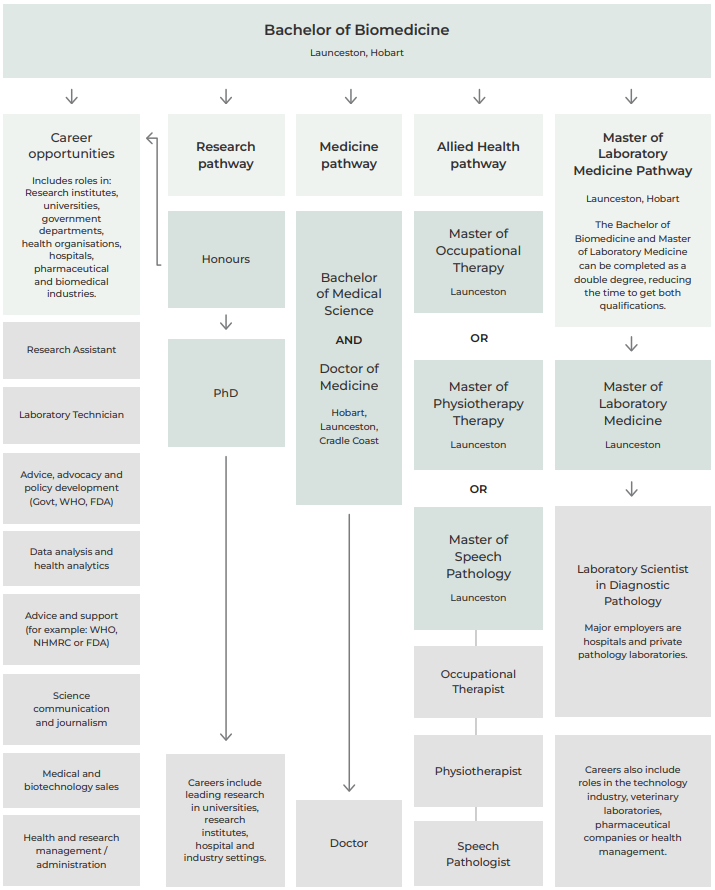
This degree sets you up for success in a wide range of careers - or as a pathway to further study in areas such as allied health, medicine, or medical research.
You might consider:
- An Honours year to build your research experience. This is available through the Bachelor of Medical Research with Honours.
- Postgraduate Allied Health qualifications in fields like physiotherapy, speech pathology or occupational therapy.
- Laboratory Medicine, via the Master of Laboratory Medicine or our new Bachelor of Biomedicine/Master of Laboratory Medicine double degree -graduate with both in just four years.
- Medicine, with pathways into medicine available through the University of Tasmania. Visit the medicine course page to learn more.
- 1 Apply and translate biomedical science knowledge in the context of health and disease
- 2 Conduct experiments, analyse and interpret scientific data in a responsible and safe manner
- 3 Source, critically evaluate and synthesise information relevant to biomedicine
- 4 Communicate biomedical information in a range of modes to a variety of audiences
- 5 Conduct work individually and collaboratively within legal, ethical and professional frameworks relevant to the biomedicine discipline
Our biomedicine course is designed and taught by active medical researchers at the Tasmanian School of Medicine and the School of Health Sciences. It also draws on the expertise of our specialist research and teaching institutes: the Menzies Institute for Medical Research, and the Wicking Dementia Research and Education Centre. As the single university for Tasmania, we provide unparalleled access and connection to the local community, health system, and institutes. This means that throughout your studies you are learning from experts who are directly engaged with the health sector both locally, nationally, and internationally.
Global connections and job-ready experiences
We also provide access to the global knowledgebase of research groups, institutes, and organisations through our ongoing collaborations and research. You’ll develop valuable knowledge, skills and confidence in research methodology, scientific observation, and analysis, and advance your ability to identify and solve problems, think critically, and communicate science to a broad audience.
Capstone project units in each major provide the opportunity to engage with external stakeholders and industry through project work. These projects give you real-world experience of the knowledge and skills developed during your studies, plus help you build networks and connections to support you finding your career path upon graduation.
Career outcomes

Make a difference in healthcare and research
The recent global health crisis has shown just how vital biomedicine is in managing and treating disease - both for individuals and entire populations. With a strong foundation in biomedical science, this degree equips you with the skills to undertake technical analysis and research to support medical scientists and clinicians in advancing knowledge, and in the diagnosis, treatment, and prevention of disease.
You’ll apply your scientific expertise to better understand illnesses and medical challenges, without being limited to a single discipline. Your skills will be in demand across a wide range of sectors, in Australia and internationally.
Career opportunities include:
- Medical scientist Medical researcher
- Geneticist Epidemiologist
- Science communicator
- Policy advisor
- Disease surveillance officer
You’ll be well suited to roles in:
- Research institutes and university departments
- Hospitals and pathology laboratories
- Pharmaceutical and biomedical companies
- Industry, government, NGOs, and public health organisations
Specialist skills through the Bachelor of Biomedicine/Master of Laboratory Medicine
If you choose to study the Bachelor of Biomedicine/Master of Laboratory Medicine double degree, you’ll graduate with specialist laboratory medicine skills that are highly sought after in Australia and abroad. This includes:
- Hands-on learning across a breadth of laboratory medicine disciplines
- A 16-week placement to build real-world experience
- Career readiness for roles in hospital and private pathology labs, public health and specialised laboratories, animal health labs, and blood transfusion services.
Many of our Master of Laboratory Medicine students secure employment before graduation, thanks to the depth of their training and practical experience.
A growing industry The healthcare industry in Australia is projected to grow by over 25% by 2034*
*National Skills Commission ten year projections from May 2024-May 2034.
Guaranteed entry pathway to Allied Health courses for Tasmanian high school graduates
This degree offers a pathway to further studies in physiotherapy, speech pathology, and occupational therapy. Up to 10 places in each of the three courses are reserved for Tasmanian students who have finished their Tasmanian Certificate of Education (TCE) or International Baccalaureate (IB) in the last 12 months.
The pathway needs to be applied for separately, with applications due on 1 December 2026.
Visit the Allied Health Pathway page to find out more
Biomedicine career pathways
Explore the science of health and disease and discover a world of possibilities. A Bachelor of Biomedicine can lead to careers in research, biotechnology, diagnostics, public health and beyond, helping shape the future of healthcare and scientific discovery.
Course structure
The Bachelor of Biomedicine requires the completion of 300 credit points of study comprising:
- 8 Core units (100 credit points)
- 1 Major (100 credit points)
- 8 Elective units or a second Major (100 credit points)
For your major, you can select from the Medical Research or Medical Science major as your primary study focus.
In the elective component you can choose from any units marked as ‘Student Electives’ which you meet the pre-requisites for, at any level, from across the university. Your electives can be used in several ways:
- You can add breadth to your degree, by exploring a variety of different subject areas from within or outside the College of Health and Medicine.
- You can deepen your engagement with specific subject areas, for example, by completing additional units in the same discipline as your major or related fields.
- You can use the elective space to enrol in units that will meet the pre-requisites for, or provide credit into, post-graduate study in a range of disciplines, including Laboratory Medicine, Physiotherapy and Speech Pathology.
- You can also use this elective space to complete a second Major, which may be a major in this course or from another course, noting that some exclusions apply.
The University is deeply committed to building sustainable futures which is why we've made our Sustainability major readily available in most of our courses. If you want to complete this major, you'll find it under your Electives options when you go to enrol, and you can add it to your study plan yourself. To find out more about the Sustainability major, check the Electives below.
To select another major from this course or from another course, you'll need to contact a Student Advisor via U Connect. They'll guide you through adding this to your study plan, and make sure it fits with the rest of your course plan.For help on how to find and choose your Elective units, see What are Elective units?
This unit focuses on the fundamental cellular mechanisms involved in health and disease. The emphasis is on cellular processes that can protect or injure cells and body systems, as well as genetic factors and biological and environmental agents that can…
Credit Points: 12.5
| Location | Study period | Attendance options | Available to | ||
|---|---|---|---|---|---|
| Hobart | Semester 2 |  |  |  | |
| Launceston | Semester 2 | | | | |
- Key:
- On-campus
 Off-Campus
- International students
- Domestic students
This unit focuses on molecular biology in human health and disease. You will be introduced to processes regulating gene expression; protein structure-function relationships; proteostasis and post-translational modification mechanisms; and signalling pathways controlling cell fate, cell cycle and apoptosis. You will…
Credit Points: 12.5
| Location | Study period | Attendance options | Available to | ||
|---|---|---|---|---|---|
| Hobart | Semester 2 | | | | |
| Launceston | Semester 2 | | | | |
- Key:
- On-campus
- Off-Campus
- International students
- Domestic students
View all details for CBA265 Molecular Biology in Health & Disease
This unit involves on-campus-based learning activities that integrates a range of topics in the areas of pharmaceutics and pharmacology focusing on the physical and chemical factors influencing drug formulation, absorption, distribution, metabolism, excretion, and pharmacological action. This critical knowledge is…
Credit Points: 12.5
| Location | Study period | Attendance options | Available to | ||
|---|---|---|---|---|---|
| Hobart | Semester 1 | | | | |
| Launceston | Semester 1 | | | | |
- Key:
- On-campus
- Off-Campus
- International students
- Domestic students
View all details for CSA116 Molecular Basis of Pharmaceutics and Pharmacology
This unit will give you a broad and detailed understanding of the immune system and its functions. The curriculum includes both theoretical and practical sessions focusing on the structure and development of the immune system, antigen presentation and recognition, effector…
Credit Points: 12.5
| Location | Study period | Attendance options | Available to | ||
|---|---|---|---|---|---|
| Hobart | Semester 2 | | | | |
| Launceston | Semester 2 | | | | |
- Key:
- On-campus
- Off-Campus
- International students
- Domestic students
This unit is designed to introduce you to human cells and tissues and the anatomy and physiology of the integumentary, defence, musculoskeletal and neuroendocrine systems in the human body. The unit will include: (a) the basic facts and concepts relating…
Credit Points: 12.5
| Location | Study period | Attendance options | Available to | ||
|---|---|---|---|---|---|
| Hobart | Semester 1 | | | | |
| Launceston | Semester 1 | | | | |
| Online | Semester 1 | | | | |
| Sydney | Semester 1 | | | | |
- Key:
- On-campus
- Off-Campus
- International students
- Domestic students
This unit is designed to introduce you to the anatomy and physiology of the reproductive, cardiovascular, respiratory, renal, and digestive systems of the human body. The regulation of body temperature will also be studied in the unit. The unit will…
Credit Points: 12.5
| Location | Study period | Attendance options | Available to | ||
|---|---|---|---|---|---|
| Hobart | Semester 2 | | | | |
| Launceston | Semester 2 | | | | |
| Online | Semester 2 | | | | |
| Sydney | Semester 2 | | | | |
- Key:
- On-campus
- Off-Campus
- International students
- Domestic students
This unit focuses on enzymes and metabolic and nutritional biochemistry in human health and disease. You will be introduced to enzyme function, kinetics and regulation; the metabolism of carbohydrates, lipids and amino acids; and the integration and hormonal regulation of…
Credit Points: 12.5
| Location | Study period | Attendance options | Available to | ||
|---|---|---|---|---|---|
| Hobart | Semester 1 | | | | |
- Key:
- On-campus
- Off-Campus
- International students
- Domestic students
View all details for CBA260 Biochemistry: Metabolism & Nutrition
Metabolic biochemistry entails the study of intermediary metabolism and the structures involved. This unit is concerned mainly with the metabolic processes involved in the inter-conversion and storage of metabolic energy, the regulation of these processes and the associated molecules. Specifically,…
Credit Points: 12.5
| Location | Study period | Attendance options | Available to | ||
|---|---|---|---|---|---|
| Launceston | Semester 1 | | | | |
- Key:
- On-campus
- Off-Campus
- International students
- Domestic students
Human Physiology (CHP207) builds on first year Biology-based units and gives you an understanding of the function of the cardiovascular, respiratory, renal and nervous systems and their integration and interaction in the human body. You will learn how to collect…
Credit Points: 12.5
| Location | Study period | Attendance options | Available to | ||
|---|---|---|---|---|---|
| Hobart | Semester 1 | | | | |
- Key:
- On-campus
- Off-Campus
- International students
- Domestic students
By engaging with this unit, you will develop the ability to critically explain and apply the physiological principles that underpin human responses and adaptations to exercise. You will build the skills to analyse respiratory, cardiovascular, muscular, neural, and endocrine contributions…
Credit Points: 12.5
| Location | Study period | Attendance options | Available to | ||
|---|---|---|---|---|---|
| Launceston | Semester 1 | | | | |
- Key:
- On-campus
- Off-Campus
- International students
- Domestic students
Students are required to study 8 units to complete the Major which comprise the following:
25 credit points in Year 1;
25 credit points in Year 2 and
50 credit points in Year 3
This unit introduces the determinants of health and wellbeing including lifestyle, social and cultural factors. Students are introduced to the types of measures that are used in reporting health information and the ways in which this information is presented and…
Credit Points: 12.5
| Location | Study period | Attendance options | Available to | ||
|---|---|---|---|---|---|
| Hobart | Semester 1 | | | | |
| Launceston | Semester 1 | | | | |
- Key:
- On-campus
- Off-Campus
- International students
- Domestic students
View all details for CXA103 Health: Determinants and Analysis
This unit introduces you to the fundamental concepts and methods relevant to health science and research literacy, offering perspectives from a range of health professions and fields of medical research. It will equip you with the skills to locate, evaluate,…
Credit Points: 12.5
| Location | Study period | Attendance options | Available to | ||
|---|---|---|---|---|---|
| Hobart | Semester 2 | | | | |
| Launceston | Semester 2 | | | | |
| Online | Semester 1 | | | | |
| Semester 2 | | | | ||
- Key:
- On-campus
- Off-Campus
- International students
- Domestic students
This unit will consolidate and build on research skills that have been developed in first units within the Bachelor of Medical Research and will cover the principles of research design and analysis, ethics in medical research, scientific controversy, scientific critique…
Credit Points: 12.5
| Location | Study period | Attendance options | Available to | ||
|---|---|---|---|---|---|
| Hobart | Semester 1 | | | | |
| Launceston | Semester 1 | | | | |
- Key:
- On-campus
- Off-Campus
- International students
- Domestic students
View all details for CAM203 Contemporary Issues in Medical Research
This unit focuses on the key elements of experimental design, data analysis and communication in the context of medical research. In this unit, you will learn about design, data considerations and statistical analysis from different research disciplines including epidemiology, clinical…
Credit Points: 12.5
| Location | Study period | Attendance options | Available to | ||
|---|---|---|---|---|---|
| Hobart | Semester 2 | | | | |
| Launceston | Semester 2 | | | | |
- Key:
- On-campus
- Off-Campus
- International students
- Domestic students
View all details for CAM204 Experimental Design and Analysis in Medical Research
This unit provides students with an understanding of how contemporary approaches in molecular biology are being used to address problems in human health and wellbeing. This includes an introduction to genomics and proteomics. The use of molecular biology and protein…
Credit Points: 12.5
| Location | Study period | Attendance options | Available to | ||
|---|---|---|---|---|---|
| Hobart | Semester 1 | | | | |
| Launceston | Semester 1 | | | | |
- Key:
- On-campus
- Off-Campus
- International students
- Domestic students
View all details for CAM312 Biomolecular Approaches to Medical Research
This unit provides students with an understanding of how systems-based approaches are being used to address problems in human health and wellbeing. Students will plan and undertake experiments investigating disease mechanism using systems-based tools and approaches to data collection and…
Credit Points: 12.5
| Location | Study period | Attendance options | Available to | ||
|---|---|---|---|---|---|
| Hobart | Semester 2 | | | | |
| Launceston | Semester 2 | | | | |
- Key:
- On-campus
- Off-Campus
- International students
- Domestic students
View all details for CAM313 Systems-based Approaches to Medical Research
This unit provides students with an understanding of recent developments and contemporary issues in the areas of biochemistry and molecular biology. Areas covered include topics related to signal transduction, gene regulation and epigenetics, and DNA damage and repair. Topics are…
Credit Points: 12.5
| Location | Study period | Attendance options | Available to | ||
|---|---|---|---|---|---|
| Hobart | Semester 2 | | | | |
- Key:
- On-campus
- Off-Campus
- International students
- Domestic students
View all details for CBA343 Advanced Biochemistry and Molecular Biology
Genetics forms the nexus between human biology and the environment with almost every human disease having a genetic component. This course covers the basic tenets of human genetics, introducing genetic concepts and building on these throughout the course. This will…
Credit Points: 12.5
| Location | Study period | Attendance options | Available to | ||
|---|---|---|---|---|---|
| Hobart | Semester 1 | | | | |
- Key:
- On-campus
- Off-Campus
- International students
- Domestic students
This unit provides an in-depth journey into neuroscience, with a particular focus on cellular and systems neuroscience: how neurons work together to create functional circuits. Learning material will cover the structure and function of the nervous system in the context…
Credit Points: 12.5
| Location | Study period | Attendance options | Available to | ||
|---|---|---|---|---|---|
| Hobart | Semester 2 | | | | |
- Key:
- On-campus
- Off-Campus
- International students
- Domestic students
The unit focuses on medical molecular genetics, providing detailed study of genetic mutations and inheritance patterns of genetic diseases. Laboratory sessions will cover molecular diagnostic techniques.…
Credit Points: 12.5
| Location | Study period | Attendance options | Available to | ||
|---|---|---|---|---|---|
| Launceston | Semester 1 | | | | |
- Key:
- On-campus
- Off-Campus
- International students
- Domestic students
This research project-based unit provides you the opportunity to work with a research group to develop your research skills, including skills in experiment planning and design and conducting a research project. You will also develop skills in scientific communication by…
Credit Points: 12.5
| Location | Study period | Attendance options | Available to | ||
|---|---|---|---|---|---|
| Hobart | Semester 2 | | | | |
| Launceston | Semester 2 | | | | |
- Key:
- On-campus
- Off-Campus
- International students
- Domestic students
Students are required to study 8 units to complete the Major which comprise the following:
25 credit points in Year 1;
25 credit points in Year 2 and
50 credit points in Year 3
This unit introduces the determinants of health and wellbeing including lifestyle, social and cultural factors. Students are introduced to the types of measures that are used in reporting health information and the ways in which this information is presented and…
Credit Points: 12.5
| Location | Study period | Attendance options | Available to | ||
|---|---|---|---|---|---|
| Hobart | Semester 1 | | | | |
| Launceston | Semester 1 | | | | |
- Key:
- On-campus
- Off-Campus
- International students
- Domestic students
View all details for CXA103 Health: Determinants and Analysis
This unit introduces you to the fundamental concepts and methods relevant to health science and research literacy, offering perspectives from a range of health professions and fields of medical research. It will equip you with the skills to locate, evaluate,…
Credit Points: 12.5
| Location | Study period | Attendance options | Available to | ||
|---|---|---|---|---|---|
| Hobart | Semester 2 | | | | |
| Launceston | Semester 2 | | | | |
| Online | Semester 1 | | | | |
| Semester 2 | | | | ||
- Key:
- On-campus
- Off-Campus
- International students
- Domestic students
This unit introduces students to the foundation knowledge, skills and conceptual frameworks that underpin contemporary public health practice. It explores the biological, social, economic and environmental determinants of health and wellbeing as a basis for developing strategies and systems that…
Credit Points: 12.5
| Location | Study period | Attendance options | Available to | ||
|---|---|---|---|---|---|
| Hobart | Semester 1 | | | | |
| Online | Semester 1 | | | | |
- Key:
- On-campus
- Off-Campus
- International students
- Domestic students
In this unit, you will examine foundational knowledge of the anatomy and physiology relating to structures of the head, neck and thorax. The functional anatomy and physiology of the head, neck and thorax are examined with a focus on structures…
Credit Points: 12.5
| Location | Study period | Attendance options | Available to | ||
|---|---|---|---|---|---|
| Online | Semester 1 | | | | |
| Semester 2 | | | | ||
- Key:
- On-campus
- Off-Campus
- International students
- Domestic students
View all details for CXA112 Anatomy and Physiology of the Head, Neck and Thorax
Speech pathology is the study, diagnosis and treatment of communication and swallowing disorders, and draws on many diverse fields to maximise people’s ability to communicate and participate in their daily lives. Linguistics provides a key foundation to understanding communication and…
Credit Points: 12.5
| Location | Study period | Attendance options | Available to | ||
|---|---|---|---|---|---|
| Online | Semester 1 | | | | |
| Semester 2 | | | | ||
- Key:
- On-campus
- Off-Campus
- International students
- Domestic students
View all details for CXA113 Introductory Linguistics for Speech Pathology
In this online unit, you will develop your understanding of culture and the need for cultural responsiveness and cultural safety. You will begin to see culture in broad terms, and to explore the cultural and social influences that shape your…
Credit Points: 12.5
| Location | Study period | Attendance options | Available to | ||
|---|---|---|---|---|---|
| Online | Semester 1 | | | | |
| Semester 2 | | | | ||
- Key:
- On-campus
- Off-Campus
- International students
- Domestic students
View all details for CZZ104 Living and Working with Cultural Diversity
Cell Biology, Genetics and Evolution is a core first year unit for BSc students majoring in Plant Science and important for any student studying Biological Sciences. Cell biology, genetics and evolution are fundamental to an understanding of the processes of…
Credit Points: 12.5
| Location | Study period | Attendance options | Available to | ||
|---|---|---|---|---|---|
| Hobart | Semester 2 | | | | |
- Key:
- On-campus
- Off-Campus
- International students
- Domestic students
View all details for KPZ164 Cell Biology, Genetics and Evolution
Brain and Behaviour provides an introduction to key topics in psychology with an emphasis on their biological basis. Topics include biological psychology, sensation and perception, learning, motivation, emotion, human development, language, and states of consciousness. Key theories and related research…
Credit Points: 12.5
| Location | Study period | Attendance options | Available to | ||
|---|---|---|---|---|---|
| Cradle Coast | Semester 1 | | | | |
| Hobart | Semester 1 | | | | |
| Launceston | Semester 1 | | | | |
| Online | Semester 1 | | | | |
- Key:
- On-campus
- Off-Campus
- International students
- Domestic students
Human behaviour is universal, but its expression, nature, and intent vary across cultures and contexts. Why do individuals behave the way they do? Lecture content will introduce and explore theoretical descriptions of individual differences such as personality and intelligence that…
Credit Points: 12.5
| Location | Study period | Attendance options | Available to | ||
|---|---|---|---|---|---|
| Cradle Coast | Semester 2 | | | | |
| Hobart | Semester 2 | | | | |
| Launceston | Semester 2 | | | | |
| Online | Semester 2 | | | | |
- Key:
- On-campus
- Off-Campus
- International students
- Domestic students
View all details for PSY124 Mental Health and Individual Differences
Chronic health conditions are the leading cause of illness, disability and death in Australia. This unit will explore the aetiology and epidemiology of the most common chronic diseases, exploring the risk factors which contribute to disease, the underlying mechanisms which…
Credit Points: 12.5
| Location | Study period | Attendance options | Available to | ||
|---|---|---|---|---|---|
| Hobart | Semester 1 | | | | |
| Launceston | Semester 1 | | | | |
- Key:
- On-campus
- Off-Campus
- International students
- Domestic students
This unit provides an introduction to the study of therapeutic agents, probing into the fundamental concepts of therapeutic agent-target interactions and the intricate processes governing therapeutic agent metabolism within the human body. A major part of the unit consists of…
Credit Points: 12.5
| Location | Study period | Attendance options | Available to | ||
|---|---|---|---|---|---|
| Hobart | Semester 2 | | | | |
| Launceston | Semester 2 | | | | |
- Key:
- On-campus
- Off-Campus
- International students
- Domestic students
This unit provides students with an understanding of recent developments and contemporary issues in the areas of biochemistry and molecular biology. Areas covered include topics related to signal transduction, gene regulation and epigenetics, and DNA damage and repair. Topics are…
Credit Points: 12.5
| Location | Study period | Attendance options | Available to | ||
|---|---|---|---|---|---|
| Hobart | Semester 2 | | | | |
- Key:
- On-campus
- Off-Campus
- International students
- Domestic students
View all details for CBA343 Advanced Biochemistry and Molecular Biology
Genetics forms the nexus between human biology and the environment with almost every human disease having a genetic component. This course covers the basic tenets of human genetics, introducing genetic concepts and building on these throughout the course. This will…
Credit Points: 12.5
| Location | Study period | Attendance options | Available to | ||
|---|---|---|---|---|---|
| Hobart | Semester 1 | | | | |
- Key:
- On-campus
- Off-Campus
- International students
- Domestic students
The unit focuses on medical molecular genetics, providing detailed study of genetic mutations and inheritance patterns of genetic diseases. Laboratory sessions will cover molecular diagnostic techniques.…
Credit Points: 12.5
| Location | Study period | Attendance options | Available to | ||
|---|---|---|---|---|---|
| Launceston | Semester 1 | | | | |
- Key:
- On-campus
- Off-Campus
- International students
- Domestic students
In this unit, you will explore the cellular and molecular functions of the human immune system in health and disease; the molecular pathogenic mechanisms of selected infectious agents causing disease in humans; and the use of antibiotics and antibiotic resistance…
Credit Points: 12.5
| Location | Study period | Attendance options | Available to | ||
|---|---|---|---|---|---|
| Hobart | Semester 1 | | | | |
- Key:
- On-campus
- Off-Campus
- International students
- Domestic students
View all details for CAM311 Inflammation, Infection and Immunity
In this unit, you will develop practical skills in microbiological techniques to accurately identify medically relevant bacteria, supported by knowledge of taxonomy and key theoretical concepts. You will relate bacterial structure, function, and genetics to explain growth, disease processes, and…
Credit Points: 12.5
| Location | Study period | Attendance options | Available to | ||
|---|---|---|---|---|---|
| Launceston | Semester 1 | | | | |
- Key:
- On-campus
- Off-Campus
- International students
- Domestic students
View all details for CXA341 General and Medical Microbiology
This unit provides an opportunity for you to study the topographical and systems macroscopic anatomy of the human limbs and trunk. Emphasis is placed upon the identification and description of structures and the correlation of structure with function. This includes…
Credit Points: 12.5
| Location | Study period | Attendance options | Available to | ||
|---|---|---|---|---|---|
| Hobart | Semester 2 | | | | |
- Key:
- On-campus
- Off-Campus
- International students
- Domestic students
This unit provides an in-depth journey into neuroscience, with a particular focus on cellular and systems neuroscience: how neurons work together to create functional circuits. Learning material will cover the structure and function of the nervous system in the context…
Credit Points: 12.5
| Location | Study period | Attendance options | Available to | ||
|---|---|---|---|---|---|
| Hobart | Semester 2 | | | | |
- Key:
- On-campus
- Off-Campus
- International students
- Domestic students
This unit develops your understanding of the pathological processes that underlie various human diseases at a cellular, tissue and organ level. Histopathological methods and microscopic recognition are used to demonstrate disease processes such as inflammation, fibrosis and neoplasia. A range…
Credit Points: 12.5
| Location | Study period | Attendance options | Available to | ||
|---|---|---|---|---|---|
| Launceston | Semester 2 | | | | |
- Key:
- On-campus
- Off-Campus
- International students
- Domestic students
Introduces you to diagnostic medical bacteriology. Skills taught include: processing of clinical specimens, recognition of normal microbiota, identification of pathogens and the undertaking of appropriate antimicrobial susceptibility tests. Students learn: aspects of laboratory safety, epidemiology, pathogenesis and control of infectious…
Credit Points: 12.5
| Location | Study period | Attendance options | Available to | ||
|---|---|---|---|---|---|
| Launceston | Semester 2 | | | | |
- Key:
- On-campus
- Off-Campus
- International students
- Domestic students
CAM314 is a capstone unit that consolidates knowledge and skills developed across the degree through a project-based investigation of a contemporary health challenge. Students apply a structured Needs Assessment framework to define the problem, synthesise relevant medical and public health…
Credit Points: 12.5
| Location | Study period | Attendance options | Available to | ||
|---|---|---|---|---|---|
| Hobart | Semester 2 | | | | |
| Launceston | Semester 2 | | | | |
- Key:
- On-campus
- Off-Campus
- International students
- Domestic students
View all details for CAM314 Advocacy and Engagement Project in Medical Sciences
Developing sustainable societies is a major challenge of the Anthropocene. This Major allows students to explore the interdisciplinary knowledge and skills that underpin the development of sustainable societies and solutions. Informed by international and local research, practice and theory, this program allows students to develop specialist expertise across the physical and social sciences and humanities. With an emphasis on student-led and problem-based learning, this Major provides the frameworks for developing sustainability solutions in a range of fields and careers.
This Major is for students interested in developing sustainable societies. Informed by international and local research, practice and theory, the Major allows students to develop specialist expertise across physical and social sciences and humanities.
Major Co-ordinator: Aidan Davison
Sustainability is a central concept for communities pursuing social and economic goals within ecological limits. Yet the different ways sustainability is defined, communicated and enacted reflects the wide range of underlying values, perspectives and priorities at stake. In this unit,…
Credit Points: 12.5
| Location | Study period | Attendance options | Available to | ||
|---|---|---|---|---|---|
| Online | Semester 1 | | | | |
| Semester 2 | | | | ||
- Key:
- On-campus
- Off-Campus
- International students
- Domestic students
Contemporary media is saturated with images of extreme weather events, hunger, poverty, conflict, pollution, austerity, and financial crisis. Mounting evidence suggests the 21st century will be defined by unprecedented challenges related to environmental instability, economic inequality and risks to social…
Credit Points: 12.5
| Location | Study period | Attendance options | Available to | ||
|---|---|---|---|---|---|
| Online | Semester 1 | | | | |
- Key:
- On-campus
- Off-Campus
- International students
- Domestic students
Earth is a lively and dynamic planet that is undergoing rapid changes wrought by the activities of humans. In what ways are these changes impacting on us and other species? Are we precipitating another mass extinction; the 6th major mass…
Credit Points: 12.5
| Location | Study period | Attendance options | Available to | ||
|---|---|---|---|---|---|
| Online | Semester 2 | | | | |
- Key:
- On-campus
- Off-Campus
- International students
- Domestic students
KGA171 Global Geographies of Change introduces you to how geography helps us understand today’s world. The unit explores key issues such as climate change, natural hazards, vulnerability, sustainability, population, development, and territory. You will learn how people and environments interact,…
Credit Points: 12.5
| Location | Study period | Attendance options | Available to | ||
|---|---|---|---|---|---|
| Hobart | Semester 1 | | | | |
| Online | Semester 1 | | | | |
- Key:
- On-campus
- Off-Campus
- International students
- Domestic students
In this unit, you will be introduced to the concept of sustainability starting with the transformations necessary for achieving the 17 United Nations Sustainable Development Goals (SDGs) in a way that organises them into 6 logical groups. You will examine…
Credit Points: 12.5
| Location | Study period | Attendance options | Available to | ||
|---|---|---|---|---|---|
| Online | Semester 1 | | | | |
| Semester 2 | | | | ||
- Key:
- On-campus
- Off-Campus
- International students
- Domestic students
This capstone unit will give you the opportunity to bring together your learnings and apply sustainability knowledge and literacy to aspects of your own life, and to identify how it can contribute to sustainable outcomes within your wider community and…
Credit Points: 12.5
| Location | Study period | Attendance options | Available to | ||
|---|---|---|---|---|---|
| Online | Semester 1 | | | | |
| Semester 2 | | | | ||
- Key:
- On-campus
- Off-Campus
- International students
- Domestic students
View all details for KGA107 Local Lives for a Sustainable Planet
This unit takes an interdisciplinary approach to understanding complex adaptive systems and developing practical skills in systems thinking. It is structured into five inter-related modules, beginning and ending with philosophical reflection on the human capacity to think about systems. Students…
Credit Points: 12.5
| Location | Study period | Attendance options | Available to | ||
|---|---|---|---|---|---|
| Online | Semester 1 | | | | |
- Key:
- On-campus
- Off-Campus
- International students
- Domestic students
Practical, public policy-orientated lectures and tutorials in this unit explore the practical issues of resource management using international, Australian and Tasmanian case studies. There will be specific focus on the sustainable yield of fisheries and the management of forests for…
Credit Points: 12.5
| Location | Study period | Attendance options | Available to | ||
|---|---|---|---|---|---|
| Hobart | Semester 1 | | | | |
| Online | Semester 1 | | | | |
- Key:
- On-campus
- Off-Campus
- International students
- Domestic students
This unit introduces students to the study of political ideas focusing on some of the major ideological frameworks that have and continue to guide political action in the modern era. In the unit, students will consider liberal, conservative, Marxist, fascist,…
Credit Points: 12.5
| Location | Study period | Attendance options | Available to | ||
|---|---|---|---|---|---|
| Hobart | Semester 2 | | | | |
| Online | Semester 2 | | | | |
- Key:
- On-campus
- Off-Campus
- International students
- Domestic students
Society needs professional environmental managers who have the knowledge and skills to effectively tackle problems of sustainable resource use, climate change and biodiversity conservation. Environmental managers also play an important role in helping communities identify and move towards sustainable and…
Credit Points: 12.5
| Location | Study period | Attendance options | Available to | ||
|---|---|---|---|---|---|
| Hobart | Semester 2 | | | | |
| Online | Semester 2 | | | | |
| Shanghai Ocean University | Shanghai Semester 1 | | | ||
- Key:
- On-campus
- Off-Campus
- International students
- Domestic students
The most complex and important challenges facing societies today bring together concerns about environmental, political, economic, and cultural sustainability. Guided by an interdisciplinary teaching team with expertise in life sciences, social sciences, and business, this unit enables you to investigate…
Credit Points: 12.5
| Location | Study period | Attendance options | Available to | ||
|---|---|---|---|---|---|
| Online | Semester 1 | | | | |
- Key:
- On-campus
- Off-Campus
- International students
- Domestic students
View all details for KGA301 Change Agents for Sustainability
This unit investigates the components of a healthy and sustainable food system (production to consumption) from a multidisciplinary perspective, focusing on the domains of health, environment, economy and society. Students will critically analyse the concept of the ‘Sustainable Diet’ and…
Credit Points: 12.5
| Location | Study period | Attendance options | Available to | ||
|---|---|---|---|---|---|
| Online | Semester 1 | | | | |
- Key:
- On-campus
- Off-Campus
- International students
- Domestic students
This unit explores the different ways in which our everyday lives are connected increasingly to global events, issues and problems. Through three core modules – Approaches to Globalisation; Global Challenges and Threats; and, Global Futures – you will discover why…
Credit Points: 12.5
| Location | Study period | Attendance options | Available to | ||
|---|---|---|---|---|---|
| Hobart | Semester 1 | | | | |
| Online | Semester 1 | | | | |
- Key:
- On-campus
- Off-Campus
- International students
- Domestic students
View all details for HGA343 Globalisation and Society: Power, Inequality and Conflict
In this unit you will undertake a funded 4-week immersive trip to an Indo-Pacific nation, engaging with leaders from public, private and civil society, to explore the impact of global environmental issues at the local level. Working individually, and in…
Credit Points: 25
| Location | Study period | Attendance options | Available to | ||
|---|---|---|---|---|---|
| Cradle Coast | Trimester | | | | |
| Hobart | Trimester | | | | |
| Launceston | Trimester | | | | |
- Key:
- On-campus
- Off-Campus
- International students
- Domestic students
Political ecology is a diverse area of study, professional practice and activism that integrates the pursuit of justice, sustainability and development. Political ecology builds intellectual and emotional clarity by unearthing root causes of environmental problems and guiding transformative actions to…
Credit Points: 12.5
| Location | Study period | Attendance options | Available to | ||
|---|---|---|---|---|---|
| Hobart | Semester 2 | | | | |
| Online | Semester 2 | | | | |
- Key:
- On-campus
- Off-Campus
- International students
- Domestic students
View all details for KGA308 Political Ecologies of Development
This unit will equip students with an interdisciplinary understanding of energy systems. Its focus is on how science and policy are interacting to shape Australia’s energy futures. The Australian energy sector is experiencing a period of change, prompted by the…
Credit Points: 12.5
| Location | Study period | Attendance options | Available to | ||
|---|---|---|---|---|---|
| Hobart | Semester 2 | | | | |
| Online | Semester 2 | | | | |
- Key:
- On-campus
- Off-Campus
- International students
- Domestic students
View all details for KGA319 Science and Policy for Energy Futures
Immerse yourself in real-world sustainability by engaging in a sustainability-based placement experience. You will be presented with dynamic sustainability opportunities where you will apply your skills, knowledge and University studies to engage with industry and community led projects and participate in…
Credit Points: 12.5
| Location | Study period | Attendance options | Available to | ||
|---|---|---|---|---|---|
| Cradle Coast | Semester 1 | | | | |
| Semester 2 | | | | ||
| Hobart | Semester 1 | | | | |
| Semester 2 | | | | ||
| Launceston | Semester 1 | | | | |
| Semester 2 | | | | ||
- Key:
- On-campus
- Off-Campus
- International students
- Domestic students
View all details for SPE301 Sustainability Placement Experience
The Bachelor of Biomedicine and Master of Laboratory Medicine requires students to complete 31 units (400 credit points) which consist of:
- 100 credit points of core units from the Bachelor of Biomedicine
- 50 credit points of units from the Medical Sciences Major
- 50 credit points of elective units
- 200 credit points of core units from the Master of Laboratory Medicine including a 16-week Professional Experience Placement (PEP) in a NATA-accredited diagnostic pathology laboratory (or equivalent).
This unit focuses on the fundamental cellular mechanisms involved in health and disease. The emphasis is on cellular processes that can protect or injure cells and body systems, as well as genetic factors and biological and environmental agents that can…
Credit Points: 12.5
| Location | Study period | Attendance options | Available to | ||
|---|---|---|---|---|---|
| Hobart | Semester 2 | | | | |
| Launceston | Semester 2 | | | | |
- Key:
- On-campus
- Off-Campus
- International students
- Domestic students
This unit focuses on molecular biology in human health and disease. You will be introduced to processes regulating gene expression; protein structure-function relationships; proteostasis and post-translational modification mechanisms; and signalling pathways controlling cell fate, cell cycle and apoptosis. You will…
Credit Points: 12.5
| Location | Study period | Attendance options | Available to | ||
|---|---|---|---|---|---|
| Hobart | Semester 2 | | | | |
| Launceston | Semester 2 | | | | |
- Key:
- On-campus
- Off-Campus
- International students
- Domestic students
View all details for CBA265 Molecular Biology in Health & Disease
This unit involves on-campus-based learning activities that integrates a range of topics in the areas of pharmaceutics and pharmacology focusing on the physical and chemical factors influencing drug formulation, absorption, distribution, metabolism, excretion, and pharmacological action. This critical knowledge is…
Credit Points: 12.5
| Location | Study period | Attendance options | Available to | ||
|---|---|---|---|---|---|
| Hobart | Semester 1 | | | | |
| Launceston | Semester 1 | | | | |
- Key:
- On-campus
- Off-Campus
- International students
- Domestic students
View all details for CSA116 Molecular Basis of Pharmaceutics and Pharmacology
This unit will give you a broad and detailed understanding of the immune system and its functions. The curriculum includes both theoretical and practical sessions focusing on the structure and development of the immune system, antigen presentation and recognition, effector…
Credit Points: 12.5
| Location | Study period | Attendance options | Available to | ||
|---|---|---|---|---|---|
| Hobart | Semester 2 | | | | |
| Launceston | Semester 2 | | | | |
- Key:
- On-campus
- Off-Campus
- International students
- Domestic students
This unit is designed to introduce you to human cells and tissues and the anatomy and physiology of the integumentary, defence, musculoskeletal and neuroendocrine systems in the human body. The unit will include: (a) the basic facts and concepts relating…
Credit Points: 12.5
| Location | Study period | Attendance options | Available to | ||
|---|---|---|---|---|---|
| Hobart | Semester 1 | | | | |
| Launceston | Semester 1 | | | | |
| Online | Semester 1 | | | | |
| Sydney | Semester 1 | | | | |
- Key:
- On-campus
- Off-Campus
- International students
- Domestic students
This unit is designed to introduce you to the anatomy and physiology of the reproductive, cardiovascular, respiratory, renal, and digestive systems of the human body. The regulation of body temperature will also be studied in the unit. The unit will…
Credit Points: 12.5
| Location | Study period | Attendance options | Available to | ||
|---|---|---|---|---|---|
| Hobart | Semester 2 | | | | |
| Launceston | Semester 2 | | | | |
| Online | Semester 2 | | | | |
| Sydney | Semester 2 | | | | |
- Key:
- On-campus
- Off-Campus
- International students
- Domestic students
This unit focuses on enzymes and metabolic and nutritional biochemistry in human health and disease. You will be introduced to enzyme function, kinetics and regulation; the metabolism of carbohydrates, lipids and amino acids; and the integration and hormonal regulation of…
Credit Points: 12.5
| Location | Study period | Attendance options | Available to | ||
|---|---|---|---|---|---|
| Hobart | Semester 1 | | | | |
- Key:
- On-campus
- Off-Campus
- International students
- Domestic students
View all details for CBA260 Biochemistry: Metabolism & Nutrition
Metabolic biochemistry entails the study of intermediary metabolism and the structures involved. This unit is concerned mainly with the metabolic processes involved in the inter-conversion and storage of metabolic energy, the regulation of these processes and the associated molecules. Specifically,…
Credit Points: 12.5
| Location | Study period | Attendance options | Available to | ||
|---|---|---|---|---|---|
| Launceston | Semester 1 | | | | |
- Key:
- On-campus
- Off-Campus
- International students
- Domestic students
Human Physiology (CHP207) builds on first year Biology-based units and gives you an understanding of the function of the cardiovascular, respiratory, renal and nervous systems and their integration and interaction in the human body. You will learn how to collect…
Credit Points: 12.5
| Location | Study period | Attendance options | Available to | ||
|---|---|---|---|---|---|
| Hobart | Semester 1 | | | | |
- Key:
- On-campus
- Off-Campus
- International students
- Domestic students
By engaging with this unit, you will develop the ability to critically explain and apply the physiological principles that underpin human responses and adaptations to exercise. You will build the skills to analyse respiratory, cardiovascular, muscular, neural, and endocrine contributions…
Credit Points: 12.5
| Location | Study period | Attendance options | Available to | ||
|---|---|---|---|---|---|
| Launceston | Semester 1 | | | | |
- Key:
- On-campus
- Off-Campus
- International students
- Domestic students
Students are required to study 8 units to complete the Major which comprise the following:
25 credit points in Year 1;
25 credit points in Year 2 and
50 credit points of postgraduate units studied in the Master of Laboratory Medicine, which will count towards both the Bachelor of Biomedicine and the Master of Laboratory Medicine.
This unit introduces the determinants of health and wellbeing including lifestyle, social and cultural factors. Students are introduced to the types of measures that are used in reporting health information and the ways in which this information is presented and…
Credit Points: 12.5
| Location | Study period | Attendance options | Available to | ||
|---|---|---|---|---|---|
| Hobart | Semester 1 | | | | |
| Launceston | Semester 1 | | | | |
- Key:
- On-campus
- Off-Campus
- International students
- Domestic students
View all details for CXA103 Health: Determinants and Analysis
This unit introduces you to the fundamental concepts and methods relevant to health science and research literacy, offering perspectives from a range of health professions and fields of medical research. It will equip you with the skills to locate, evaluate,…
Credit Points: 12.5
| Location | Study period | Attendance options | Available to | ||
|---|---|---|---|---|---|
| Hobart | Semester 2 | | | | |
| Launceston | Semester 2 | | | | |
| Online | Semester 1 | | | | |
| Semester 2 | | | | ||
- Key:
- On-campus
- Off-Campus
- International students
- Domestic students
Chronic health conditions are the leading cause of illness, disability and death in Australia. This unit will explore the aetiology and epidemiology of the most common chronic diseases, exploring the risk factors which contribute to disease, the underlying mechanisms which…
Credit Points: 12.5
| Location | Study period | Attendance options | Available to | ||
|---|---|---|---|---|---|
| Hobart | Semester 1 | | | | |
| Launceston | Semester 1 | | | | |
- Key:
- On-campus
- Off-Campus
- International students
- Domestic students
This unit provides an introduction to the study of therapeutic agents, probing into the fundamental concepts of therapeutic agent-target interactions and the intricate processes governing therapeutic agent metabolism within the human body. A major part of the unit consists of…
Credit Points: 12.5
| Location | Study period | Attendance options | Available to | ||
|---|---|---|---|---|---|
| Hobart | Semester 2 | | | | |
| Launceston | Semester 2 | | | | |
- Key:
- On-campus
- Off-Campus
- International students
- Domestic students
The unit focuses on medical molecular genetics, providing detailed study of genetic mutations and inheritance patterns of genetic diseases. Laboratory sessions will cover molecular diagnostic techniques.…
Credit Points: 12.5
| Location | Study period | Attendance options | Available to | ||
|---|---|---|---|---|---|
| Launceston | Semester 1 | | | | |
- Key:
- On-campus
- Off-Campus
- International students
- Domestic students
This unit develops your understanding of the pathological processes that underlie various human diseases at a cellular, tissue and organ level. Histopathological methods and microscopic recognition are used to demonstrate disease processes such as inflammation, fibrosis and neoplasia. A range…
Credit Points: 12.5
| Location | Study period | Attendance options | Available to | ||
|---|---|---|---|---|---|
| Launceston | Semester 2 | | | | |
- Key:
- On-campus
- Off-Campus
- International students
- Domestic students
In this unit, you will develop practical skills in microbiological techniques to accurately identify medically relevant bacteria, supported by knowledge of taxonomy and key theoretical concepts. You will relate bacterial structure, function, and genetics to explain growth, disease processes, and…
Credit Points: 12.5
| Location | Study period | Attendance options | Available to | ||
|---|---|---|---|---|---|
| Launceston | Semester 1 | | | | |
- Key:
- On-campus
- Off-Campus
- International students
- Domestic students
View all details for CXA341 General and Medical Microbiology
Introduces you to diagnostic medical bacteriology. Skills taught include: processing of clinical specimens, recognition of normal microbiota, identification of pathogens and the undertaking of appropriate antimicrobial susceptibility tests. Students learn: aspects of laboratory safety, epidemiology, pathogenesis and control of infectious…
Credit Points: 12.5
| Location | Study period | Attendance options | Available to | ||
|---|---|---|---|---|---|
| Launceston | Semester 2 | | | | |
- Key:
- On-campus
- Off-Campus
- International students
- Domestic students
Progression to Master of Laboratory Medicine
To progress into the Master of Laboratory Medicine you will need to attain a Grade Point Average of 5 in your first two years of Bachelor-level study. On completion of Years 1 and 2, your progress will be assessed and, if approved (subject to the GPA and quota requirements), you will be admitted to H7L Master of Laboratory Medicine to complete Years 3 and 4 of the double degree. If you do not meet these requirements, you'll be able to continue completion of the standard 3-year Bachelor of Biomedicine.
The unit accommodates students with varied prior knowledge of molecular biology with an introductory module on basic molecular biology concepts and then focuses on medical molecular genetics, providing detailed study of genetic mutations, inheritance patterns of genetic diseases and laboratory…
Credit Points: 12.5
| Location | Study period | Attendance options | Available to | ||
|---|---|---|---|---|---|
| Launceston | Semester 1 | | | | |
- Key:
- On-campus
- Off-Campus
- International students
- Domestic students
In this unit you will integrate and apply learning from previous clinical laboratory medicine units, about the diagnosis and management of complex diseases. A whole of laboratory approach is used to explain the relationship between pathology results and the pathology/pathophysiology…
Credit Points: 12.5
| Location | Study period | Attendance options | Available to | ||
|---|---|---|---|---|---|
| Launceston | Semester 1 | | | | |
- Key:
- On-campus
- Off-Campus
- International students
- Domestic students
In Haematology 1, you will study blood cells, the blood-forming organs, and some blood diseases, including their aetiology, diagnosis, monitoring and treatment. In the first half of the unit, you will study normal haemopoiesis, routine haematological screening procedures, recognition of…
Credit Points: 12.5
| Location | Study period | Attendance options | Available to | ||
|---|---|---|---|---|---|
| Launceston | Semester 1 | | | | |
- Key:
- On-campus
- Off-Campus
- International students
- Domestic students
In this unit, you will integrate and extend prior knowledge and skills about the laboratory differentiation of normal and abnormal haematological health conditions gained in CXA631 Haematology 1. You will systematically investigate the causes, laboratory investigations and treatment of anaemia…
Credit Points: 12.5
| Location | Study period | Attendance options | Available to | ||
|---|---|---|---|---|---|
| Launceston | Semester 2 | | | | |
- Key:
- On-campus
- Off-Campus
- International students
- Domestic students
This unit covers the major blood group systems of relevance to human blood transfusion and the theoretical basis of common transfusion testing practices. We explore the donation of blood products and the management of transfusion services and study in detail,…
Credit Points: 12.5
| Location | Study period | Attendance options | Available to | ||
|---|---|---|---|---|---|
| Launceston | Semester 1 | | | | |
- Key:
- On-campus
- Off-Campus
- International students
- Domestic students
In this unit, you will extend your practical skills in microbiological techniques to accurately identify medically relevant bacteria, drawing on advanced understanding of taxonomy and theoretical concepts. You will critically relate bacterial structure, function, and genetics to interpret growth, disease…
Credit Points: 12.5
| Location | Study period | Attendance options | Available to | ||
|---|---|---|---|---|---|
| Launceston | Semester 1 | | | | |
- Key:
- On-campus
- Off-Campus
- International students
- Domestic students
View all details for CXA641 General and Medical Microbiology
Introduces you to diagnostic medical bacteriology. Skills taught include: processing of clinical specimens, recognition of normal microbiota, identification of pathogens and the undertaking of appropriate antimicrobial susceptibility tests. Students learn: aspects of laboratory safety, epidemiology, pathogenesis and control of infectious…
Credit Points: 12.5
| Location | Study period | Attendance options | Available to | ||
|---|---|---|---|---|---|
| Launceston | Semester 2 | | | | |
- Key:
- On-campus
- Off-Campus
- International students
- Domestic students
This unit has been designed to systematically introduce the students to the common and diagnostically important fungal, parasitic and viral diseases of major organ systems in humans. The unit content is primarily concerned with laboratory diagnostic aspects of the above…
Credit Points: 12.5
| Location | Study period | Attendance options | Available to | ||
|---|---|---|---|---|---|
| Launceston | Semester 1 | | | | |
- Key:
- On-campus
- Off-Campus
- International students
- Domestic students
This unit develops expertise in the application and critical evaluation of biochemical investigations in the clinical laboratory. You will evaluate and apply quality assurance processes, including internal and external quality control, while developing advanced laboratory and analytical technical skills, including…
Credit Points: 12.5
| Location | Study period | Attendance options | Available to | ||
|---|---|---|---|---|---|
| Launceston | Semester 1 | | | | |
- Key:
- On-campus
- Off-Campus
- International students
- Domestic students
This unit builds on foundational knowledge in Clinical Chemistry and extends your theoretical and practical capability in clinical biochemistry. You will investigate biochemical and physiological changes associated with disease and how these changes are detected, validated and interpreted through laboratory…
Credit Points: 12.5
| Location | Study period | Attendance options | Available to | ||
|---|---|---|---|---|---|
| Launceston | Semester 2 | | | | |
- Key:
- On-campus
- Off-Campus
- International students
- Domestic students
This is a professional experience placement (PEP) unit, undertaken while off campus in diagnostic pathology laboratories accredited by the National Association of Testing Authorities (NATA), or equivalent. Students develop a holistic view of the role of the diagnostic pathology laboratory…
Credit Points: 12.5
| Location | Study period | Attendance options | Available to | ||
|---|---|---|---|---|---|
| Launceston | Semester 2 | | | | |
- Key:
- On-campus
- Off-Campus
- International students
- Domestic students
This is a professional experience placement (PEP) unit undertaken off campus in diagnostic pathology laboratories accredited by the National Association of Testing Authorities (NATA), or equivalent. You are subject to the rules and regulations of your host laboratory, supervised by…
Credit Points: 12.5
| Location | Study period | Attendance options | Available to | ||
|---|---|---|---|---|---|
| Launceston | Semester 2 | | | | |
- Key:
- On-campus
- Off-Campus
- International students
- Domestic students
This is a professional experience placement (PEP) unit, undertaken off campus in diagnostic pathology laboratories accredited by the National Association of Testing Authorities (NATA), or equivalent. Students are subject to the rules and regulations of your host laboratory, supervised by…
Credit Points: 25
| Location | Study period | Attendance options | Available to | ||
|---|---|---|---|---|---|
| Launceston | Semester 2 | | | | |
- Key:
- On-campus
- Off-Campus
- International students
- Domestic students
Entry requirements
We encourage you to apply for the courses you most want to study. If you are not eligible to enter your chosen course right now, the University’s admissions team will work with you to find the best pathway option.
Enquire online for more advice on the application process and the available pathways to enrol and study at the University of Tasmania.
Bachelor of Biomedicine
Schools Recommendation Program
Australian Year 12 students can apply for this course via our Schools Recommendation Program. Rather than an ATAR, your application is based on a recommendation by your school teachers. This can factor in your Year 11 results, an assessment of your capabilities, and other considerations.
Through the program, you can receive and accept an offer prior to completing Year 12. You will still need to finish your Year 12 studies – including any exams – to commence your studies. In addition, this course requires you to pass specific pre-requisite subjects in Year 12 (or equivalent), see below for details.
If you don’t receive an early offer for this course through the Schools Recommendation Program, you will be re-assessed for a higher preference offer once your ATAR is released.
Domestic applicants who recently completed secondary education
The minimum ATAR for this course is 75.
Applicants are ranked by ATAR and offers are made based on the number of places available. In 2026, the lowest ATAR to receive an offer into this course was 77.5 The lowest ATAR to receive an offer may change from year to year based on the number of applications we receive.
Domestic applicants with higher education study
To be eligible for an offer, you must have:
- Completed the University of Tasmania Diploma of University Studies (Health Science), or
- Previous tertiary study at Bachelor level or higher - complete or incomplete, with a minimum of 2 (25 credit points) 100 level units of study, plus the pre-requisites. If you have failed any units, the application may be subject to further review before an offer is made.
Domestic applicants with VET / TAFE study
This course does not admit students on the basis of VET / TAFE study.
Please enquire online for advice on pathways, or alternative course options.
Domestic applicants with work and life experience
This course does not admit students on the basis of work or life experience.
Please enquire online for advice on pathways, or alternative course options.
Subject Pre-requisites
These prerequisites apply to students from all educational backgrounds.
To be eligible for an offer, you must have completed studies or have experience equivalent to a satisfactory achievement in the following Tasmanian Senior Secondary subject:
- Chemistry (CHM415115)
You can enquire online for information on interstate and international equivalents to the Tasmanian senior secondary subject above. If you need assistance to meet the prerequisite, we offer foundation units that you can complete before you start your course.
All international students will need to meet the minimum English Language Requirements, University General Entry Requirements and any course specific requirements such as pre-requisite subjects, if applicable.
Bachelor of Biomedicine
English Language Requirements
This degree requires an IELTS (Academic) of 6.5, with no individual band less than 6.0 or equivalent.
For students who do not meet the English Language Requirement through citizenship or prior studies in English in an approved country, evidence of an approved English language test completed within the last 2 years must be provided.
See the English Language Requirements page for more information.
General Entry Requirements
Admission to undergraduate courses at the University of Tasmania requires the completion of qualifications equivalent to a Year 12 education in Australia.
Please review the equivalent undergraduate entry requirements to see the minimum requirement relevant to your country. The ATAR information for this course is located in the “For Domestic Students” section of the entry requirements on this page.
You can also meet the General Entry Requirement for this course with the following qualifications or prior studies:
- Complete or incomplete (minimum 25 credit points) of previous tertiary study at Bachelor level or higher, with no failures.
Subject Prerequisites
These prerequisites apply to students from all educational backgrounds.
To be an eligible for an offer, you must have completed studies or have experience equivalent to a satisfactory achievement in the following Tasmanian Senior Secondary subject:
- Chemistry (CHM415115)
You can enquire online for information on interstate and international equivalents to the Tasmanian senior secondary subject above. If you need assistance to meet the prerequisite, we offer foundation units that you can complete before you start your course.
The below information is for double degrees that have specific entry requirements due to this course being combined with a postgraduate degree. To read more about all the double degree options for this course, please visit the double degree webpage.
Bachelor of Biomedicine and Master of Laboratory Medicine (Double Degree)
Schools Recommendation Program
This course is not included in the Schools Recommendation Program (SRP). You can include this course as a preference in your SRP application, however as entry to this course is very competitive, an early offer through SRP is not available. You will be assessed for this course once your ATAR is released, and may receive an offer accordingly. You may still receive early offers to other preferences you have included.
Applicants who have recently completed secondary education
The minimum ATAR for this course is 75.
Applicants are ranked by ATAR and offers made based on the number of places available. In 2026, the lowest ATAR to receive an offer into this course was 77.5. The lowest ATAR to receive an offer may change from year to year based on the number of applications we receive.
Domestic Applicants with previous higher education study
To be eligible for an offer, you must have:
- Completed UTAS Diploma of University Studies (Health Science), or
- Previous tertiary study at Bachelor level or higher – complete or incomplete, with a minimum of 2 (25 credit points) 100 level units of study plus pre-requisites. If you have failed any units, the application may be subject to further review before an offer is made.
Applicants with previous VET / TAFE study
Applicants are not eligible for admission to this course on the basis of VET or TAFE study. You can enquire online for advice on available pathways and alternative course options.
Applications on the basis of work or life experience
Applicants are not eligible for admission to this course on the basis of work or life experience. You can enquire online for advice on available pathways and alternative course options.
Course Specific Requirements
These pre-requisites apply to students from all educational backgrounds.
To be eligible for an offer, you must have studies or experience equivalent to satisfactory achievement in the following Tasmanian Senior Secondary subject:
- Chemistry (CHM415115) or equivalent
If you have not met the required pre-requisite, you will need to complete the University of Tasmania Foundation Chemistry unit KRA161 Introduction to Chemistry before you start your course.
Safety in Practice Requirements
All students enrolling in College of Health and Medicine programs which include a Professional Experience Placement component, laboratory and/or field activity are required to establish and maintain their capacity to practice safely via Safety in Practice Requirements documentation. Please note, students in Laboratory Medicine courses are required to either provide evidence of immunity to Hepatitis B or administration of at least the first dose of a three dose course of Hepatitis B vaccination, by the start of the second week of their degree. Students must bring all documentation relating to Hepatitis B vaccination and immunity (in English) with them when they commence the course. Details on Hepatitis B vaccination and immunity can be found here.
The below information is for double degrees that have specific entry requirements due to this course being combined with a postgraduate degree. To read more about all the double degree options for this course, please visit the double degree webpage.
Bachelor of Biomedicine and Master of Laboratory Medicine (Double Degree)
English Language Requirements
This degree requires an IELTS (Academic) of 6.5, with no individual band less than 6.0.
See the English Language Requirements page for more information.
General Entry Requirements
Admission to undergraduate courses at the University of Tasmania requires the completion of qualifications equivalent to a 12th year of education in Australia.
Please review the equivalent undergraduate entry requirements to see the minimum requirement relevant to your country. The ATAR information for this course is located in the “For Domestic Students” section of the entry requirements on this page.
Applicants are ranked by their academic scores and offers made based on the number of places available.
You can also meet the General Entry Requirement for this course with the following qualifications or prior studies:
- Complete or incomplete (minimum 25 credit points) of previous tertiary study at Bachelor level or higher. If an applicant has failed any units, the application may be subject to further review before an offer is made.
Course Specific Requirements
These pre-requisites apply to students from all educational backgrounds.
To be eligible for an offer, you must have studies or experience equivalent to satisfactory achievement in the following Tasmanian Senior Secondary subject:
- Chemistry (CHM415115) or equivalent
If you have not met the required pre-requisite, you will need to complete the University of Tasmania Foundation Studies Chemistry unit KRA161 Introduction to Chemistry before you start your course.
Safety in Practice Requirements
All students enrolling in College of Health and Medicine programs which include a professional experience placement component, laboratory and/or field activity are required to establish and maintain their capacity to practice safely via Safety in Practice Requirements documentation. Please note, students in Laboratory Medicine courses are required to either provide evidence of immunity to Hepatitis B or administration of at least the first dose of a three-dose course of Hepatitis B vaccination, by the start of the second week of their degree. Students must bring all documentation relating to Hepatitis B vaccination and immunity (in English) with them when they commence the course. Details on Hepatitis B vaccination and immunity can be found here.
Applications for credit can be made in your course application. Find out more information about how to apply for a credit transfer/advanced standing at Recognition of Prior Learning.
Talk to us on 13 8827 or enquire online about your credit transfer.
Please see details in the Policy: Admission, Enrolment and Credit Policy
The Bachelor of Biomedicine incorporates an articulation arrangement with Monash University, providing a pathway to apply for the Monash University Master of Radiation Therapy (MRT). Eligible students may undertake cross-institutional study in three Monash University units (RTS4101, RTS4102, RTS4103) in Year 3, Semester 2, constituting 50 credit points within the Bachelor of Biomedicine and 24 credit points of advanced standing in the MRT. Entry to the MRT is not guaranteed and is subject to Monash University admission requirements and clinical placement availability.
If you aren’t eligible for an offer to this course yet, don’t worry! Our pathway programs are designed give you access to undergraduate courses by equipping you with the skills and knowledge you need to succeed.
Visit the Pathways to University page to find out more.
Detailed admissions information and advice for all undergraduate courses, including comprehensive, course-level student profiles, is available from UTAS Admissions.
Fees & scholarships
Domestic students
Commonwealth supported places (CSP) are available for this course. For eligible domestic students, this means your fees will be subsidised by the Australian Government. You’ll only need to pay the student contribution amount for each unit you study within the course.
Commonwealth Supported Place indicative annual fee: $9,762
How is this calculated?
This is an estimate. The calculation is based on the average full-time enrolment for this course in 2026. All figures are indicative only for 2027. Actual tuition fees will depend on specific unit enrolment, and are subject to annual increases each year. You can find the complete fee details for each unit of study on the individual unit pages. The units for this course are found in the course structure section of this page.
These figures do not include other costs such as the Student Services and Amenities Fee (SSAF). For further information, please visit Scholarships, fees and costs.
HECS-HELP loans
You may be able to defer payment of the student contribution amount by accessing a HECS-HELP loan from the Government. If eligible, you’ll only have to pay your tuition fees once you start earning above a specific amount.
Further information on student loans and a CSP eligibility checker can be found at Australian Government Study Assist.
International students
2027 annual international student tuition fee: $44,950 AUD
The standard year of study for this course is 100 credit points.
Indicative total tuition fee for international students: $ 141,705 AUD.
This total tuition fee is indicative only. Please visit fees and costs for further information on how this is calculated.
International students are charged the Student Services and Amenities Fee but this fee is incorporated in the annual rate. International students do not have to make any additional SSAF payments.
Domestic scholarships
For information on general scholarships available at the University of Tasmania, please visit the scholarships website.
International scholarships
The University of Tasmania offers a range of scholarships for international students, designed to recognise academic merit and support access to university study.
For many of our international scholarships, you will be automatically assessed when you submit your International Student Application, so no separate scholarship application is required. Some scholarships may require additional application steps. Explore our International Scholarships to learn more about available opportunities and application requirements.

Course year 2027


Share this page
How can we help?
Do you have any questions about choosing a course or applying? Get in touch.